

Extreme and Rapid Accretion in Supermassive Black Holes
17 décembre | 11h00 – 12h00
Claudio Ricci (U. Geneva)
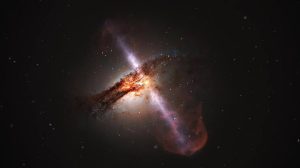
Accreting supermassive black holes are known to be variable, changing in brightness across all wavelengths and timescales. In recent years, a remarkable subset of these Active Galactic Nuclei (AGN) has been discovered to show extreme spectral variability. These changing-look events are thought to arise from extreme and rapid changes in how fast the black hole is feeding, defying the expected accretion timescales for black holes with masses of millions to billions of solar masses. Such rapid variations provide unique insights into the physics of accretion in supermassive black holes. With the upcoming Vera C. Rubin Observatory’s Legacy Survey of Space and Time (LSST), we expect to uncover thousands of these dramatic transformations, thanks to its combination of depth and rapid, repeated imaging of the sky. In this talk, I will review what we have learned about changing-look AGN so far, and look ahead to how LSST, combined with new large-scale spectroscopic surveys such as 4MOST, will open a new era in our understanding of black hole accretion physics.