
How do giant planets become eccentric?
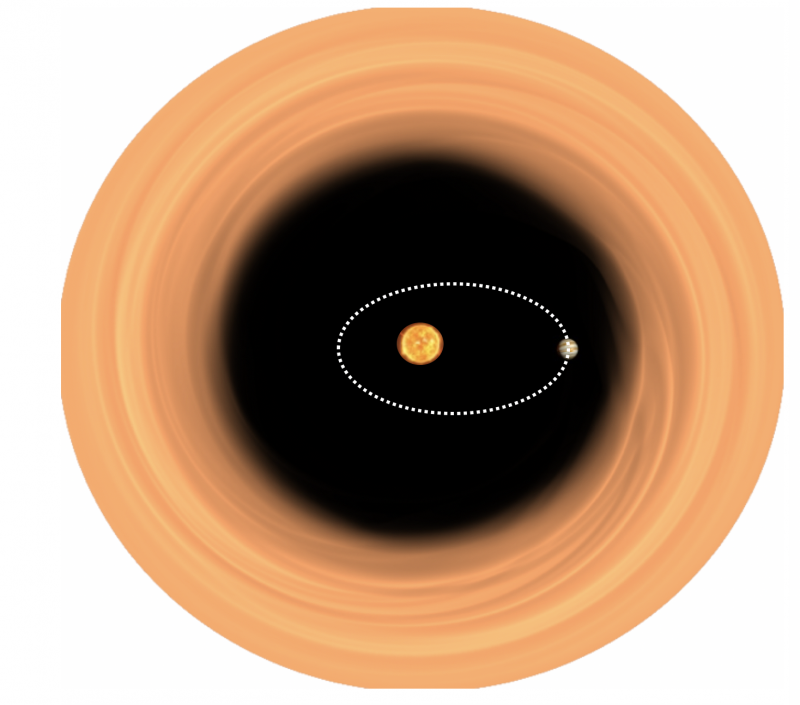
The vast majority of giant exoplanets observed (planets 100 times heavier than the Earth) have very “eccentric” orbits: their trajectory does not follow a circle, unlike the Earth, but an ellipse elongated like a rugby ball. By simulating the evolution of giant exoplanets in the disc of gas where they form, IRAP researchers have found an explanation. The orbits of these planets can become eccentric in a few thousand years when they fall into a gas-empty region (cavity).
The planets form in a disc of gas and dust around the star, the protoplanetary disc, whose radius can reach several hundred times the Earth-Sun distance. Within the disc, the planets can migrate and get closer to the star, but the gravity that the gas exerts on the planet prevents it from becoming eccentric. Hence the idea of the study: what happens if the gas has a central cavity, like a donut? Many disks have been observed with such a cavity inside them, sometimes larger than the size of the Earth’s orbit. The result is clear: when the planet falls into the cavity, the interactions with the external disc result in a very rapid increase in eccentricity, in only a few tens of thousands of years! This result thus proposes a possible explanation for the observed eccentricity of giant planets. Moreover, it suggests that the presence of a central cavity would be a common step in the evolution of protoplanetary disks.
Considering the almost circular orbits of Jupiter and Saturn, this mechanism did not occur in the Solar System. This is rather good news: if the giant planets close to the Earth were on very eccentric orbits, we would probably not be here to notice it!
Further Resources
- Scientific paper : Revisiting migration in a disc cavity to explain the high eccentricities of warm Jupiters – Monthly Notices of the Royal Astronomical Society, Volume 500, Issue 2, Florian Debras, Clément Baruteau, Jean-François Donati, https://doi.org/10.1093/mnras/staa3397
IRAP Contact
- Florian Debras, florian.debras@irap.omp.eu
- Clément Baruteau, clement.baruteau@irap.omp.eu
- Jean-François Donati, Jean-Francois.Donati@irap.omp.eu