
Ganymede and Callisto: frozen destinies with divergent origins
Two icy moons of Jupiter, although similar in size and proximity, have radically different internal structures. A new study suggests that this dichotomy has its origins in their formation, challenging current theories.
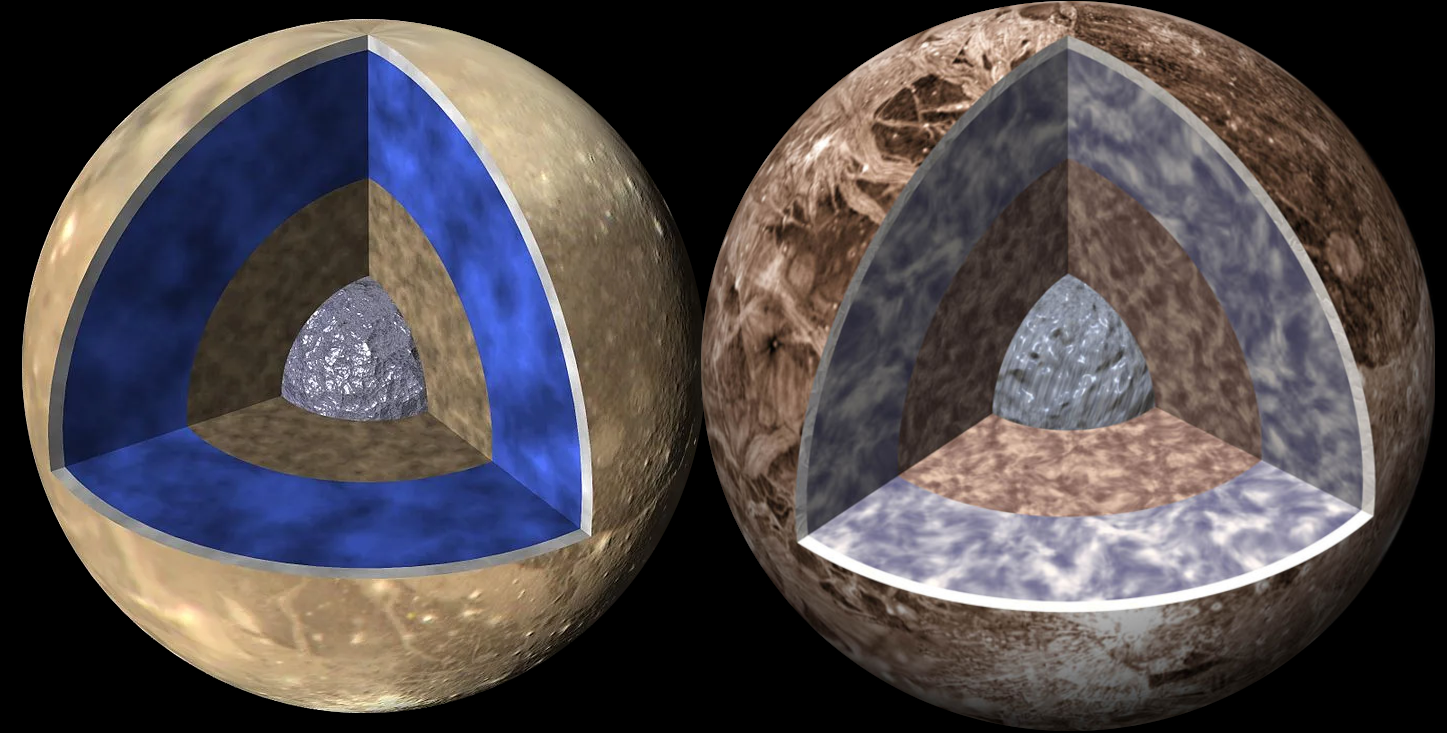
Callisto and Ganymede, two large icy moons of Jupiter, have intrigued scientists for decades. Although they are close neighbors and comparable in size, their internal structures seem surprisingly different. Data from the Galileo mission reveal that Ganymede, the largest moon in the Solar System, would have completely differentiated into a metallic core, a rocky mantle and an icy crust. Conversely, Callisto is thought to have retained only a partially differentiated internal structure, composed of a relatively homogeneous mixture of rock and ice.
A team including CNRS Terre & Univers researchers has put forward a new hypothesis: this divergence would have emerged during the formation phase, without the need to invoke major subsequent events.
By simulating accretion processes in the disk of gas and dust surrounding Jupiter, the researchers developed a thermal evolution model that takes into account all heat sources: radiogenic heating associated with short-lived radionuclides, heat produced by impacts during accretion, and thermal radiation from the circum-Jovian disk. The results of this study suggest that the dichotomy observed between Ganymede and Callisto could be naturally explained by similar formation conditions, assuming identical composition and the same impactor size distribution. Their simulations show that Ganymede would have reached the temperatures required for global melting very early on in its formation, while Callisto, formed in a cooler region of the disk, would not have crossed the water-ice melting threshold, although it may have incorporated a significant proportion of large impactors.
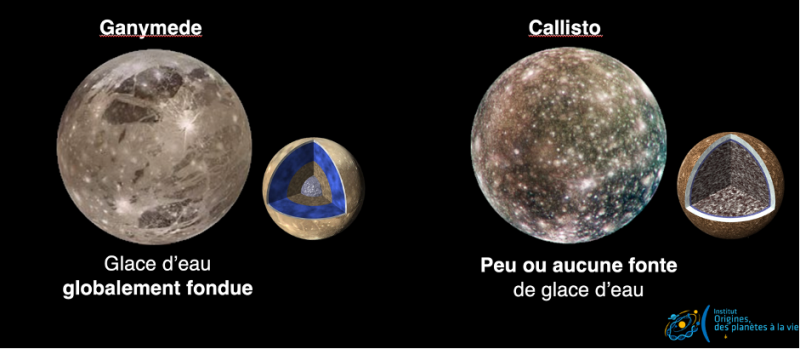
The study highlights that subtle differences, such as local temperature within the disk or orbital position relative to Jupiter, can be enough to explain radically distinct evolutionary trajectories. Ganymede, more massive and formed closer to Jupiter, was exposed to more energetic impacts and a hotter environment, conditions sufficient to trigger global fusion. Callisto, which was accreted further out into a colder region, has thus preserved a relatively undifferentiated structure. These findings call into question the prevailing hypothesis that this dichotomy is the result of secondary processes, such as late bombardments or tidal effects linked to orbital resonances. The European JUICE mission, due to arrive in the Jovian system in 2031, will play a key role in testing these hypotheses through high-precision gravitational measurements during its scheduled flybys of Callisto.
CNRS laboratories involved
- Institut de Recherche en Astrophysique et Planétologie (IRAP – OMP)
Tutelles : CNRS / Université de Toulouse / CNES - Laboratoire d’Astrophysique de Marseille (LAM – PYTHÉAS)
Tutelles : CNRS / Aix-Marseille Université
Further Resource
- Scientific article : Bennacer, Y., Mousis, O., Monnereau, M., et al. 2025, Conditions for accretion favoring an unmelted Callisto and a differentiated Ganymede. Planetary Science Journal, 2025. https://iopscience.iop.org/article/10.3847/PSJ/add719
IRAP Contact
- Marc Monnereau, marc.monnereau@irap.omp.eu