
Dawn Mission: two hypotheses on the origin of asteroid Vesta
A study published in Nature Astronomy reveals two hypotheses about the complex origin and structure of Vesta, the second largest body in the asteroid belt between Mars and Jupiter.
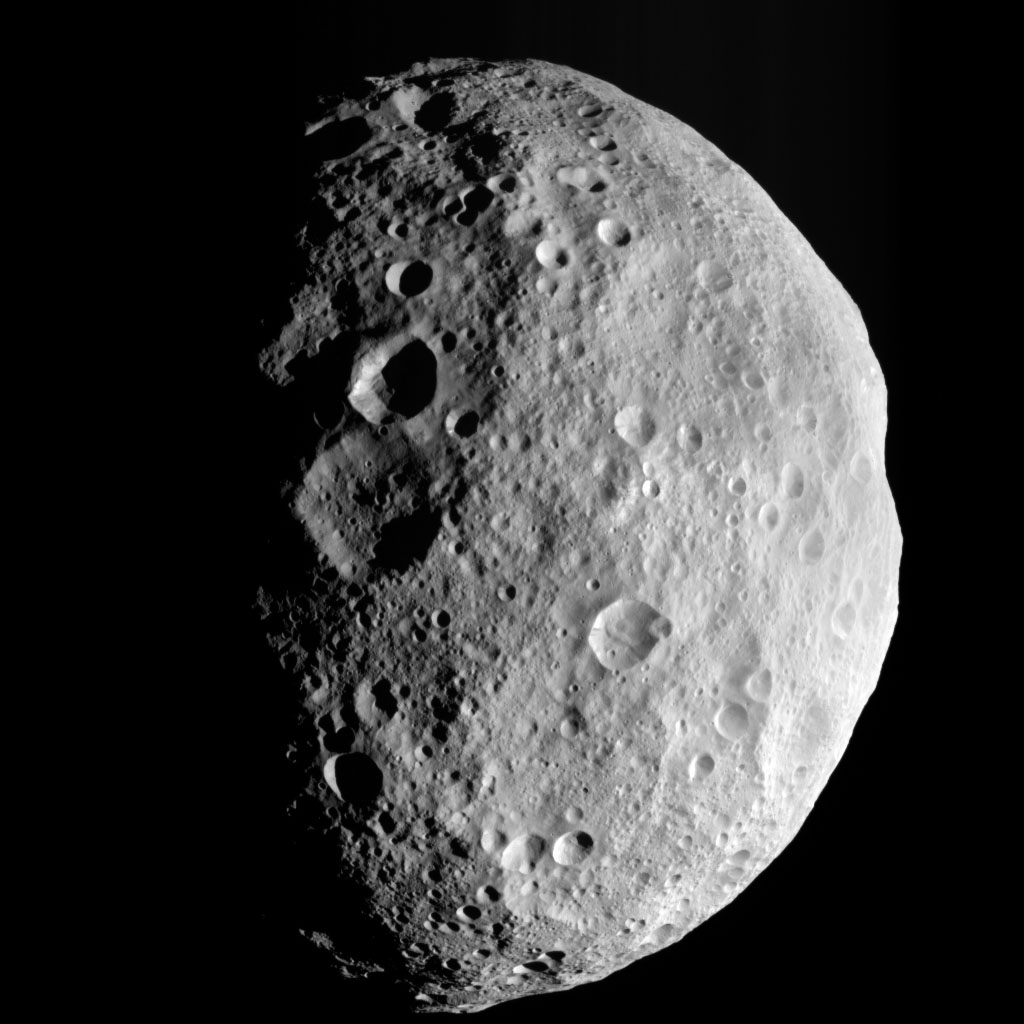
Vesta, the second largest body in the asteroid belt between Mars and Jupiter, is a precious witness to the early history of the solar system. Covered in magmatic rocks produced during the first millions of years following the condensation of the primordial nebula, Vesta has the potential to inform us about the formation and internal differentiation of the first protoplanets, the ‘building blocks’ of later planetary construction.
Data collected by NASA’s Dawn probe, which orbited Vesta from July 2011 to September 2012, provide initial answers about the asteroid’s internal structure. However, these data alone still offer a wide range of possibilities as to the body’s state of differentiation.
To go further, we need to better define the moment of inertia, a parameter that is difficult to measure precisely on a body of Vesta’s size and topographic complexity. It is in this context that a new estimate of Vesta’s moment of inertia has been deduced from Dawn’s Doppler tracking via the Deep Space Network and on-board imaging data during its stay around the asteroid.
Origin of protoplanet Vesta: two possible scenarios
These new measurements suggest that Vesta’s interior has a much more limited density stratification than previously determined. Vesta is therefore not totally differentiated, and is composed of a crust, a mantle and a small core.
Two scenarios are proposed to explain the observations. In the first, Vesta’s interior has not undergone complete differentiation due to “late” accretion. In this case, the migration of magma liquids to the surface carries the heat source, the radioelement 26Al, depriving the asteroid’s interior of the ability to melt further. This hypothesis has been shown to be consistent with the geochemical constraints of surface magmatic rocks within the framework of an overall “chondritic” composition (close to that of the nebula).
In the second scenario, Vesta could be a remnant of a larger, differentiated body that underwent a major collision, then re-accreted with an overall composition that is not necessarily chondritic.
These new results show that Vesta did not undergo complete differentiation, underlining the complexity of the processes at work in the early solar system, with complex interactions between accretion timing, 26Al redistribution, thermal evolution and/or impact processes.
CNRS laboratories involved
- Institut de Recherche en Astrophysique et planétologie (IRAP – OMP) – Tutelles : CNRS / CNES / Université de Toulouse
- Laboratoire Temps Espace (LTE – Obs Paris) – Tutelles : CNRS / Observatoire de Paris – PSL / LNE / Sorbonne Université / Université de Lille
Further Resource
- Scientific article : Park, R.S., Ermakov, A.I., Konopliv, A.S. et al. A small core in Vesta inferred from Dawn’s observations. Nat Astron (2025).
IRAP Contact
- Michael Toplis, michael.toplis@univ-toulouse.fr