
Deep long-period earthquakes discovered beneath Massif Central volcanoes
A recent study published in Geophysical Research Letters reveals atypical seismic signals beneath the volcanoes of the Massif Central. These signals, combined with the active presence of magma at depth, suggest that the magma reservoirs of the Chaîne des Puys and Pavin maar may still be active, despite 6,700 years of volcanic rest.

Geological studies have shown that volcanic eruptions have affected the Massif Central over the last 65 million years, with its last eruption 6,700 years ago, giving rise to the Pavin maar. Since then, the region has been in a state of volcanic quiescence, dependent on the stability of the magmatic reservoirs presumed to be present in the crust and upper mantle.
An unprecedented seismic campaign as part of the ANR MACIV project
As part of the ANR MACIV (Imagerie sismique multi-échelle des sources du volcanisme du Massif Central) project to probe the deep structure of the Massif Central, 100 broadband seismometers have been temporarily installed (2023-2024), completing the permanent broadband network (RLBP) of the Epos-France research infrastructure.
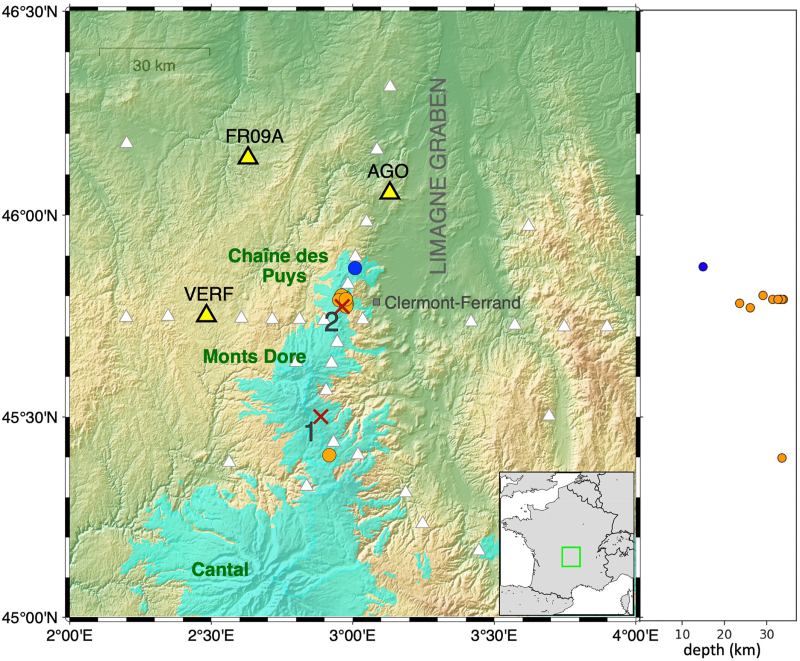
Identification of Deep Long Period (DLP) earthquakes
Data analysis has identified a number of Deep Long Period (DLP) earthquakes located near the crust-mantle boundary beneath volcanoes in the Chaine des Puys and Pavin regions.
These earthquakes, already observed beneath numerous volcanoes around the world, are interpreted as the result of the presence of active magma at depth. Their discovery may therefore indicate that deep magma reservoirs beneath certain volcanoes in the Massif Central are still active.
Given the geodynamic context and the number and frequency of events detected, the situation in the Massif Central resembles that of the Eifel volcanic massif (Germany), which has also been dormant for some ten thousand years, but where signs of renewed magmatic activity have been observed.
Prospects and challenges for Massif Central monitoring
The detection of these deep, long-period earthquakes sheds light on the state of the magmatic system beneath the Chaîne des Puys and the Pavin region. These results represent a step towards a better understanding of the long-term evolution of volcanism in the Massif Central.
These new data will complement the observations made by the Epos-France RLBP permanent seismological network, reinforcing monitoring in this dormant but potentially reactivatable volcanic region.
CNRS Laboratories involved
- Laboratoire Géosciences environnement Toulouse (GET – OMP) – Tutelles : CNRS / CNES / IRD / Université de Toulouse
- Institut de Recherche en Astrophysique et Planétologie (IRAP/OMP) – Tutelles : CNRS / CNES / Université de Toulouse
- Institut de Sciences de la Terre (ISTerre) Tutelles : CNRS / IRD / Université de Grenoble Alpes / Université Savoie Mont Blanc
- Laboratoire Magmas et Volcans (LMV) Tutelles : CNRS / IRD / Université Clermont Auvergne
Further resources
- Scientific paper : Deep Long Period Earthquakes Beneath Volcanoes of the French Massif Central, N. M. Shapiro, C. Aubert, S. Chevrot, A. Mordret, A. Paul, M. Sylvander, M. Laumonier, G. Boudoire, D. Laporte, N. Cluzel, J. Battaglia, G. Scheiblin, H. Pauchet, T. Souriot, F. Brenguier, M. Campillo, B. Plazolles, L. Gailler, E. Thébault, Geophysical Research Letters, 2025 . DOI: 10.1029/2025GL114904
- SISMalp
- Le Bureau central sismologique français
- Tremblements de terre volcaniques longue période profonds liés au dégazage de magma
IRAP Contact
- Matthieu Sylvander, Matthieu.Sylvander@irap.omp.eu