EMIR has just been installed on the GTC
The EMIR team of IRAP is pleased to announce the arrival of the EMIR instrument on the 10m GTC telescope of the Canary. This event marks the end of an adventure of almost 15 years!
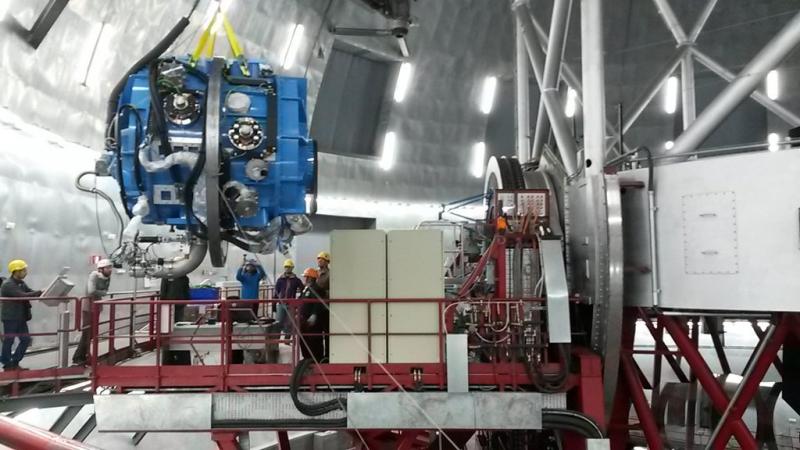
EMIR is a wide-field of view spectrograph with multi-purpose capability in the near-IR (bands z to K included). It is completely cryogenic and its resolution R ~ 4000-5000 is optimal to correct the emission of OH lines from the sky and maximize the ‘clean’ wavelength area. The instrument has a multi-slot reconfigurable mode, which is unique on an instrument of this kind, and leads to observe up to 50 sources on a field of view of 6×6 arcmin.
For its implementation, EMIR has required considerable efforts of R&D over a long time scale, at a particularly difficult time for European astronomy. It remains a unique instrument in the fields of cosmology and extragalactic, the only one telescope in the 10m class accessible to our community in the Northern Hemisphere, combining high multiplex capacity and off-pair efficiency for the study of low and compact sources in the near-IR. Its specifications are available on the GTC website (1).
These qualities make EMIR an ideal tool for the direct study of the first galaxies and the reionization period, allowing access to the physical properties of galaxies in the early stages of their assembly. Indeed, the design of EMIR has been completely determined by the scientific requirements of the survey which will be conducted with the guaranteed time of the instrument, especially the Goya project which aims at studying the grouping of galaxies and the most distant galaxies.
EMIR is a project led by the IAC in the Canaries, but it would not have been achievable without the combined efforts of teams of the LATT, next the IRAP, and our colleagues of the LAM in Marseille. The technical team in Toulouse ensured the establishment of the detectors and of the help observation software, with a significant contribution to monitoring and control, a work conducted primarily under the responsibility of F. Beigbeder, E. Bourrec, and S . Brau-Nogué. Many other engineers and researchers of Toulouse have contributed to this effort over these long years, including S. Baratchard, J.F. Le Borgne, Richard J., and J. M. Glorian. We hope EMIR will fully meet our expectations in the forthcoming months, providing nice scientific results.
Further Resources
- (1) Website of the GTC : http://www.gtc.iac.es/instruments/emir/emir.php
IRAP Contact
- Roser Pello, roser.pello@irap.omp.eu