
The SF2A Young Researcher 2022 Prize is awarded to … Audrey Coutens
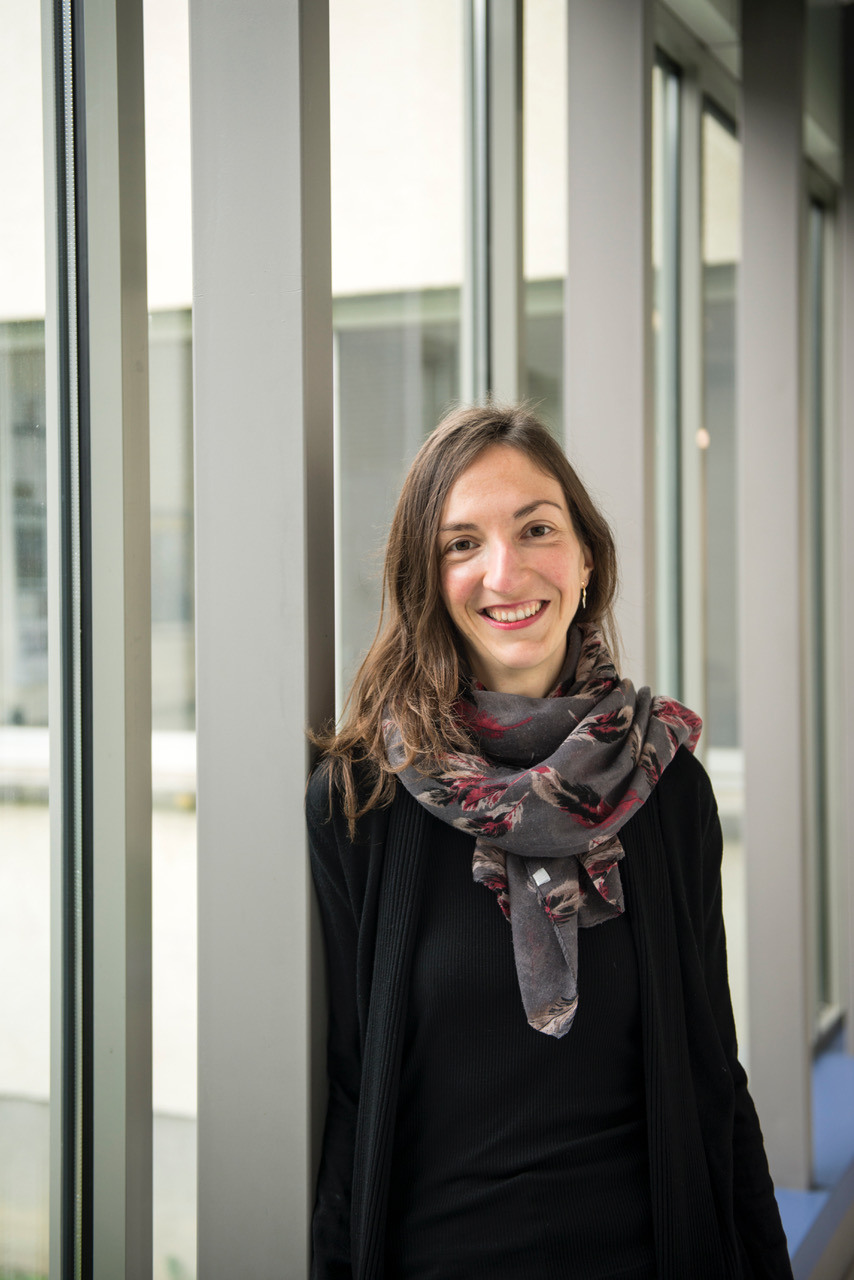
Press release of the SF2A
Audrey Coutens is an assistant astronomer at IRAP since 2021, and she carries out her research on the interstellar medium and the formation sites of solar-type stars, in particular the molecules linked to the appearance of life. To this end, she studies extensively water and complex organic molecules in these environments, at the frontier of astrophysics, astrochemistry and exobiology. Audrey Coutens combines two approaches: on the one hand, the analysis of complex spectroscopic observations obtained for example with ground-based interferometers (ALMA, SMA, NOEMA), or the Herschel space telescope. On the other hand, a modeling of the chemical evolution in the proto-planetary disks in formation. This combined approach has been the subject of an ANR tremplin-ERC, followed by an ERC Starting Grant project, which has just started.
Audrey Coutens’ observational work has allowed her to detect for the first time some complex organic molecules in the direction of solar-type protostars, as well as more generally in the interstellar medium. Her modeling work has shown that the collapse of dense cores plays a key role in the establishment of molecular complexity. His work is central to the development of future observational projects with the Square Kilometer Array. The SF2A Council also noted the important role of Audrey Coutens in the CASSIS observational service, as well as her numerous activities of knowledge diffusion.
Further Resources
- A new molecule detected in a proto-planetary disk
- L’université accueille une nouvelle astronome-adjointe à l’IRAP (OMP)
- Prix de l’Académie des Sciences, Inscriptions et Belles-Lettres
- Le télescope Herschel traque l’eau dans notre univers proche
IRAP Contact
- Audrey Coutens, audrey.coutens@irap.omp.eu