
Rosetta unveils the secrets of the origin of xenon
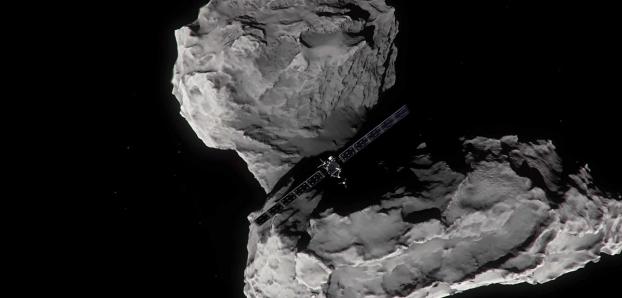
The existence of a link between the terrestrial xenon isotopic composition and that of comet 67P / Churyumov-Gerasimenko has just been demonstrated by an international consortium of researchers1 including those of the CNRS and of the universities of Lorraine, Orléans , Toulouse III – Paul Sabatier and Aix-Marseille thanks to the Rosina instrument of ESA’s Rosetta probe. Xenon is a rare gas marker of the processes of formation of the Solar System. Unlike meteorites and the Sun, the earth’s atmosphere has a specific isotopic signature: a unique case in the Solar System. The analysis of the data collected by Rosina shows that the primitive xenon brought to Earth during the early phases of formation of the Solar System is derived from a mixture of xenon coming from comets and asteroids. These results also indicate that the xenon of the comet Tchouri would be foreign to the Solar System. This study was published in Science on June 9, 2017.
Note(s):
1- Within the context of an international collaboration, this work involve the Centre de recherches pétrographiques et géochimiques (CNRS/Université de Lorraine), the Laboratoire atmosphère, milieux, observations spatiales (CNRS/UPMC/Université de Versailles Saint-Quentin-en-Yvelines) belonging to the Institut Pierre Simon Laplace, the Laboratoire de physique et chimie de l’environnement et de l’espace (CNRS/Université d’Orléans), the Laboratoire d’astrophysique de Marseille (CNRS/Aix Marseille Université) and the Institut de recherche en astrophysique et planétologie (CNRS/Université Toulouse III – Paul Sabatier).
Further Resources
- Scientific article : Xenon isotopes in 67P/Churyumov-Gerasimenko show that comets contributed to Earth’s atmosphere, B. Marty, K. Altwegg, H. Balsiger, A. Bar-Nun, D. V. Bekaert, J.-J. Berthelier,A. Bieler, C. Briois, U. Calmonte, M. Combi, J. De Keyser, B. Fiethe, S. A. Fuselier, S. Gasc, T. I. Gombosi, K. C. Hansen, M. Hässig, A. Jäckel, E. Kopp, A. Korth, L. Le Roy, U. Mall, O. Mousis, T. Owen, H. Rème, M. Rubin, T. Sémon,C.-Y. Tzou, J. H. Waite, P. Wurz,Science, 09 juin 2017.
- ESA Press Release : Rosetta finds comet connection to Earth’s atmosphere
IRAP Contact
- Henri Rème, henri.reme@irap.omp.eu