
BLACK HOLE MEAL SETS RECORD FOR LENGTH AND SIZE
A trio of X-ray observatories has captured a remarkable event in their data: a decade-long binge by a black hole almost two billion light years away. This discovery was made using data from NASA’s Chandra X-ray Observatory, Swift Observatory, and ESA’s XMM-Newton.
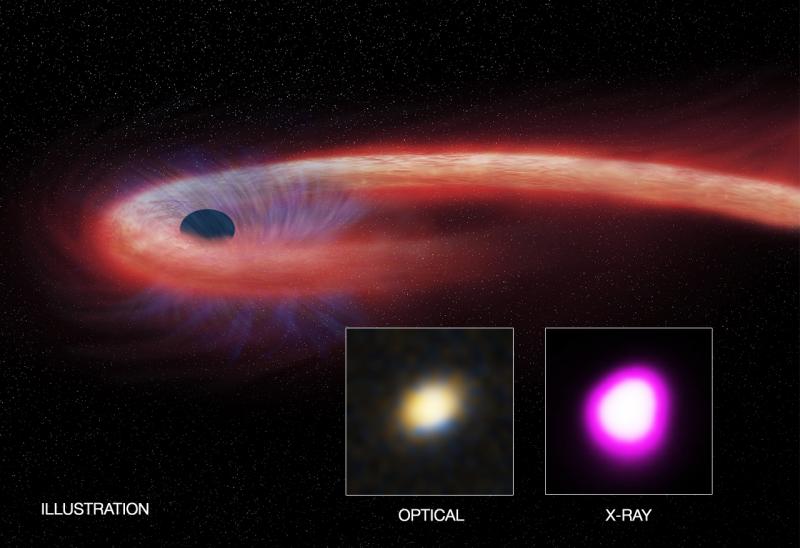
This artist’s illustration depicts what astronomers call a “tidal disruption event,” or TDE. This is when an object, such as a star, wanders too close to a black hole and is destroyed by tidal forces generated from the black hole’s intense gravitational forces. During a TDE, some of the stellar debris is flung outward at high speeds, while the rest (shown as the red material in the illustration) becomes hotter as it falls toward the black hole, generating a distinct X-ray flare. A wind blowing away from this infalling material is shown in blue.
Among observed TDEs, this event involved either the most massive star to be completely ripped apart and devoured by a black hole or the first instance where a smaller star was completely ripped apart. The resulting X-ray source is known as XJ1500+154 and is located in a small galaxy about 1.8 billion light years from Earth. The optical image in the left inset shows this galaxy, where XJ1500+0154 is found in the center of the galaxy. This implies that the source likely originates from a supermassive black hole that resides there. The inset on the right shows XJ1500+0154 in the Chandra image covering the same field.
The source was not detected in a Chandra observation on April 2, 2005, but was detected in an XMM-Newton observation on July 23, 2005, and reached peak brightness in a Chandra observation on June 5, 2008. These observations show that the source became at least 100 times brighter in X-rays. Since then, Chandra, Swift, and XMM-Newton have observed it multiple times.
The X-ray data also indicate that radiation from material surrounding this black hole has consistently surpassed the so-called Eddington limit, defined by a balance between the outward pressure of radiation from the hot gas and the inward pull of the gravity of the black hole.
This TDE may help answer the question as to how supermassive black holes in the early universe grow. If supermassive black holes can grow, from TDEs or other means, at rates above those corresponding to the Eddington limit, this could explain how supermassive black holes were able to reach masses about a billion times higher than the sun when the universe was only about a billion years old.
A paper describing these results appears on February 6th issue in Nature Astronomy. The authors are Dacheng Lin (University of New Hampshire), James Guillochon (Harvard-Smithsonian Center for Astrophysics), Stefanie Komossa (QianNan Normal University for Nationalities), Enrico Ramirez-Ruiz (University of California, Santa Cruz), Jimmy Irwin (University of Alabama), Peter Maksym (Harvard-Smithsonian), Dirk Grupe (Morehead State University), Olivier Godet (CNRS), Natalie Webb (CNRS), Didier Barret (CNRS), Ashley Zauderer (New York University), Pierre-Alain Duc (CEA-Saclay), Eleazar Carrasco (Gemini Observatory), and Stephen Gwyn (Herzberg Institute of Astrophysics).
NASA’s Marshall Space Flight Center in Huntsville, Alabama, manages the Chandra program for NASA’s Science Mission Directorate in Washington. The Smithsonian Astrophysical Observatory in Cambridge, Massachusetts, controls Chandra’s science and flight operations.
Further Resources
- Scientific article : “A likely decade-long sustained tidal disruption event“, by Lin Dacheng et al., Nature Astronomy 1, Article number: 0033 (2017), doi:10.1038/s41550-016-0033
- Website dedicated to the Chandra mission : http://chandra.si.edu/
- NASA Website news online : Black Hole Meal Sets Record for Duration And Size
- ESA website dedicated to the XMM-Newton mission : https://www.cosmos.esa.int/web/xmm-newton
- Press Releases :
IRAP Contacts
- Natalie Webb, natalie.webb@irap.omp.eu
- Olivier Godet, olivier.godet@irap.omp.eu
- Didier Barret, didier.barret@irap.omp.eu