
The MMS Mission delivers its first results
An international team including several IRAP researchers (Paul Sabatier University of Toulouse & CNRS) delivers the first results of the NASA MMS Mission (Magnetospheric Multi Scale) dedicated to the study of the Earth’s magnetosphere. This study was published on March 28, 2016 within the journal Geophysical Research Letters.
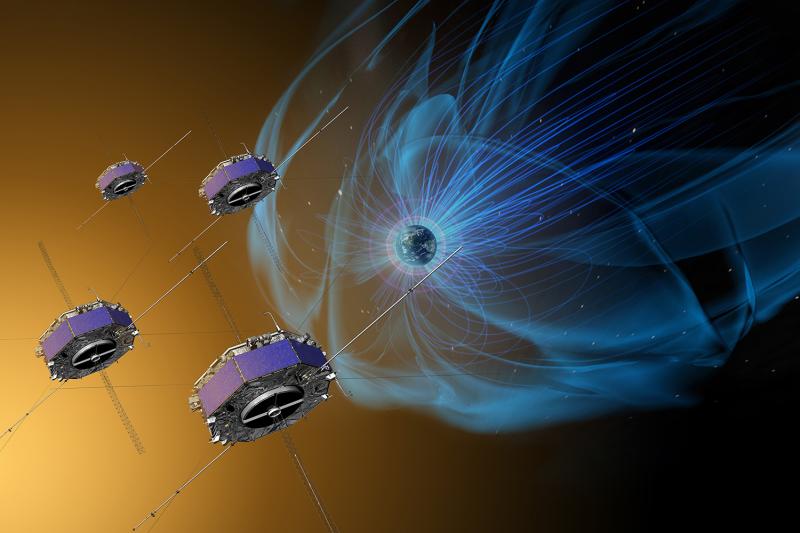
Launched on 12 March 2015 by an Atlas V rocket from the base at Cape Canaveral in Florida (1), the four satellites of NASA’s Magnetospheric Multiscale (MMS) mission were placed in equatorial orbit and in a tetrahedral configuration to study key regions of the Earth’s magnetosphere: the day side of the magnetopause, its flanks and the geomagnetic tail at short (12 Earth radii) and medium distances (25 Earth radii). To this end, each satellite carries various instruments (2) for measuring charged particles and electromagnetic fields in the ionised environment of the Earth, where the movement of particles is controlled by the Earth’s magnetic field.
The MMS mission is a continuation and a perfect complement to the CLUSTER mission launched by ESA in July 2000 and extended until the end of 2016 (3). They have many similarities, starting with the number of satellites in formation: four identical satellites, 100 to 10 000 km apart in the case of the CLUSTER mission and 10 to 160 km apart in the case of the MMS mission. However, the MMS mission benefits from the many scientific achievements of the CLUSTER mission as well as from new-generation instrumentation that makes it possible to study the phenomenon of magnetic reconnection, particle acceleration and the role of turbulence in plasmas on the scale of electron dynamics.
Since its launch, the MMS mission has made numerous observations at very high temporal resolution, the first of which have just been published in the journal Geophysical Research Letters. The MMS observations demonstrate for the first time the close relationship between the radius of curvature of the magnetic field lines and the radius of gyration of the (low energy) electrons around the magnetic field. The results highlight the fine dynamics of the electrons in the magnetic reconnection region, involving complex angular scattering and trapping processes.
These first results from the MMS mission show the need for wave and particle instruments with very high temporal resolution to understand the physical processes that develop in the interface regions between two plasmas such as at the Earth’s magnetopause or in a turbulent plasma such as the one present in the magnetogaine. The next phases of the Near Tail, Magnetopause and Far Tail missions will provide the international community with a comprehensive set of scale measurements of electron dynamics in all key regions of the Earth’s magnetosphere.
Notes
(1) Press release of 13 March 2015: “Successful launch for the MMS mission”.
(2) IRAP contributed to the mission through the provision, characterization and calibration of all 32 detector pairs (microchannel wafers) of the ion measurement experiment belonging to the Fast Plasma Investigation (FPI) consortium. Since September 1, 2015, when the mission officially entered its operational phase, IRAP researchers have been actively involved in the scientific analysis of the results and their interpretation.
(3) The CLUSTER mission aims to study the Earth’s magnetosphere and its interactions with the solar wind. ESA website dedicated to the CLUSTER mission: http://sci.esa.int/cluster/
Further Resources
- Scientific article : « Currents and associated electron scattering and bouncing near the diffusion region at Earth’s magnetopause » by B. Lavraud et al., Geophysical Research Letters, DOI: 10.1002/2016GL068359, http://onlinelibrary.wiley.com/doi/10.1002/2016GL068359/full
- Site Web de la NASA dédié à la mission MMS : http://mms.gsfc.nasa.gov/
IRAP researchers involved in this study
- B. Lavraud, Y. Vernisse, V. Génot, C. Jacquey, I. Kacem, A. Marchaudon, E. Penou, J.-A. Sauvaud
IRAP Contact
- Benoit Lavraud, Benoit.Lavraud@irap.omp.eu