
Jupiter and Saturn: a new theoretical model of giant magnetospheres
The giant planets in our Solar System are extremely complex systems. They are first characterized by their intense magnetic field, which creates a magnetic cavity, the magnetosphere, protecting their direct surroundings against solar wind and extending to tens of planetary radii. In addition, their fast rotation, with a period of approximately 9 to 10h (compared to 24h at Earth), induces a strong forcing in the magnetosphere. In the regions closest to the planet, (cryo-)volcanic moons, Enceladus at Saturn and Io at Jupiter, continuously inject gas and plasma in the system. This plasma is picked up by the magnetic field and strongly accelerated by the planetary rotation. It is transported outwards, resulting in a feedback onto the gas giant in the form of field-aligned current loops.
How exactly does this plasma transport in the system occur, knowing that, according to physical principles, it must conserve mass, energy and momentum ? A study carried out by a young PhD student at IRAP, based on fundamental magneto-hydrodynamic laws, resulted in a theoretical model describing this phenomenon in its full complexity. Published in the Journal of Geophysical Research, this work shows that, considering only the global movement of plasma, it can be understood simply as… a competition between various rotation resistances !
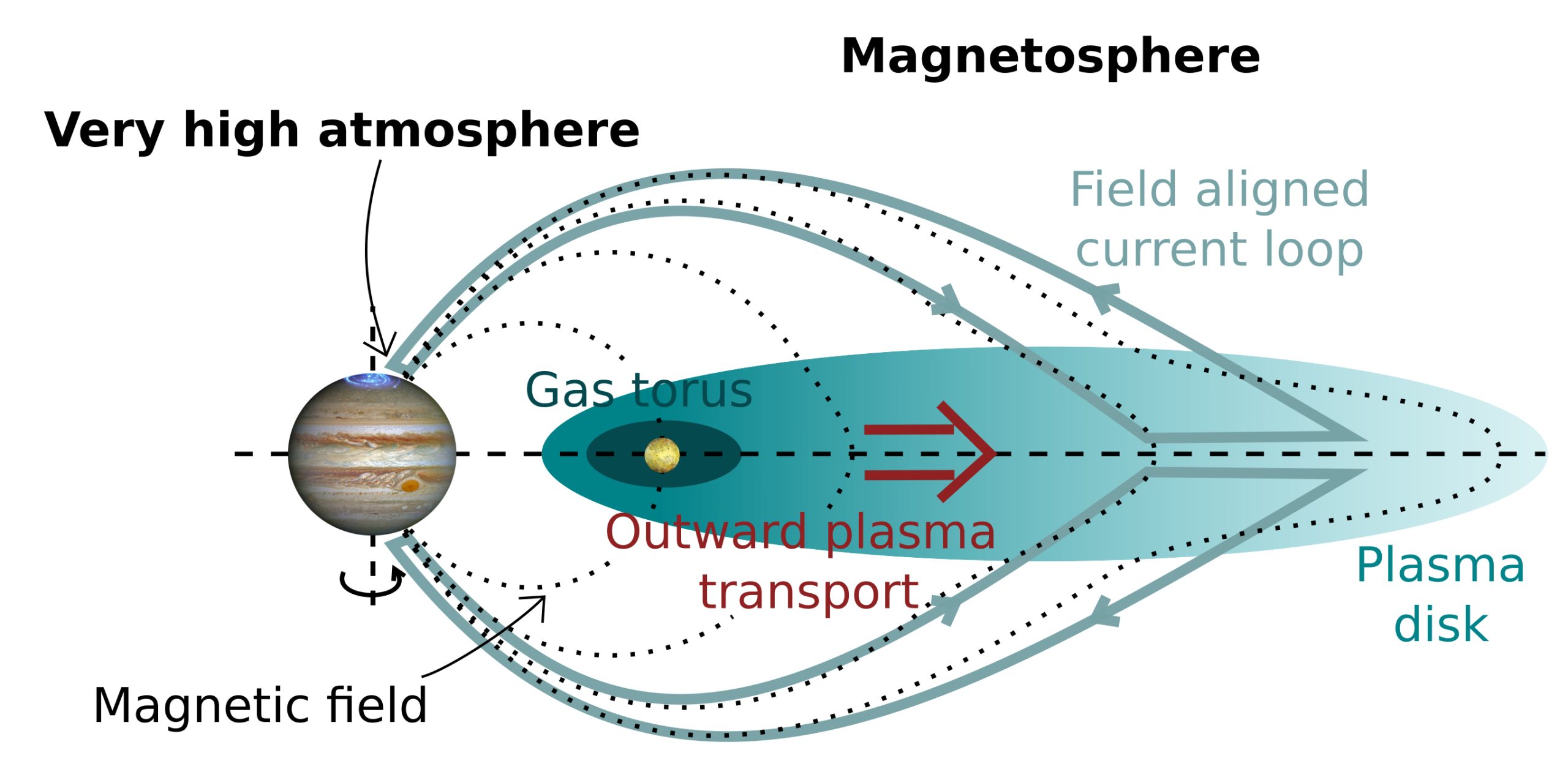
Rather general, this model could apply to the understanding of finer dynamical processes taking place in the gas giant magnetospheres, with always greater precision and complexity. It is the first model able to take into account most of the observed asymetries in the fast rotating magnetospheres. It will enable the analysis of data from probes orbiting in those systems : “retired” Cassini (Saturn) and Galileo (Jupiter), active Juno (Jupiter) and soon JUICE and Europa Clipper, which will provide a two observers’ view of the Jovian magnetosphere from 2031.
Further Resources
- Publication : Devinat, M., Blanc, M., & André, N. (2024). A self-consistent model of radial transport in the magnetodisks of gas giants including interhemispheric asymmetries. Journal of Geophysical Research: Space Physics, 129, e2023JA032233. https://doi.org/10.1029/2023JA032233
IRAP Contacts
- Marie Devinat, marie.devinat@irap.omp.eu
- Michel Blanc, Michel.Blanc@irap.omp.eu
- Nicolas André, Nicolas.Andre@irap.omp.eu