
The James Webb telescope witnesses the destruction of a terrestrial ocean every month.
An international team, including French scientists (1) from Université Paris-Saclay, Université Toulouse III – Paul Sabatier, the INCLASS joint laboratory (IAS/ACRI-ST), Observatoire de Paris-PSL, Université Grenoble Alpes, CNRS and CNES, has just demonstrated the destruction and reformation of a large quantity of water in a protoplanetary disk located at the heart of the Orion nebula. This discovery was made possible by an original multidisciplinary approach combining observations from the JWST space telescope and quantum physics calculations. This study, carried out as part of the PDRs4All (2) Early Release Science (ERS) program and led by a young researcher, Marion Zannese, a PhD student at Université Paris-Saclay, has just been published in the journal Nature Astronomy.
Water is essential to life as we know it. On Earth, most of the water in our oceans is thought to have been formed long before the birth of the Solar System, in cold regions of interstellar space (-250°C). However, a fraction of this water could have been destroyed and re-formed at higher temperatures (100-500°C) when the Solar System was still just a disk of gas and dust orbiting our young sun.
To understand this mysterious cycle of water disappearance and reappearance, astronomers turned the James Webb Telescope (JWST) to “d203-506”, a protoplanetary disk located in the Orion Nebula, a nursery of planetary systems. The intense ultraviolet radiation produced by massive stars leads to the destruction and reformation of water in d203-506, making it a veritable interstellar laboratory.
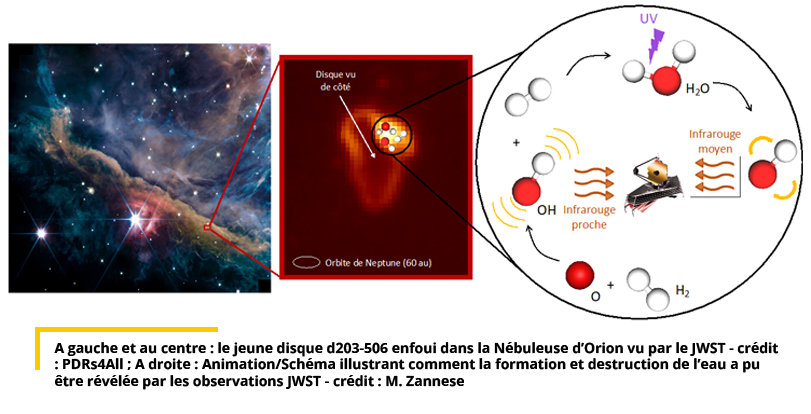
But how can we demonstrate the formation and destruction of molecules located over a thousand light-years from Earth? It was a collaboration with experts in quantum dynamics (3), involved in the modeling part, that made it possible to meet the challenge. When water (H2O) is destroyed by ultraviolet light, a hydroxyl (OH) molecule is released with a dizzying rotational motion, followed by the emission of mid-infrared photons that travel all the way to the JWST. In total, it is estimated that the equivalent of a terrestrial ocean is destroyed in this way every month in the young d203-506 system.
But the story doesn’t end there. Through a similar mechanism of near-infrared photon emission, JWST reveals that hydroxyl is produced in abundance from atomic oxygen by the O+H2 reaction. Oxygen is a key intermediate in the formation of water, since it then reacts with H2 to form water via the OH+H2 reaction. The destruction/formation cycle comes full circle. Some of the water making up our oceans could have gone through such a cycle.
Notes
- (1) In France, this research involved scientists from: Institut d’Astrophysique Spatiale (IAS – CNRS/Univ. Paris-Saclay), Institut des Sciences Moléculaires d’Orsay (ISMO – CNRS/Univ. Paris-Saclay), Institut de Recherche en Astrophysique et Planétologie (IRAP/OMP – CNES/CNRS/UT3), INCLASS Common Laboratory (IAS/ACRI-ST), LERMA (Observatoire de Paris- PSL/CNRS, Sorbonne Universités), Institut de Planétologie et d’Astrophysique de Grenoble (IPAG – Université Grenoble Alpes/CNRS), Institut de Radioastronomie Millimétrique (IRAM – UGA/CNRS/IRD/METEO-FRANCE/INRAE).
- (2) PDRs4All (https://pdrs4all.org/) is one of thirteen early release science programs selected by NASA to demonstrate the capabilities of JWST, bringing together an international consortium.
- (3) These included scientists from: the Institute of Fundamental Physics (CSIS) and the Department of Physical Chemistry at the Universidad Complutense de Madrid (UCM) (Spain), the Department of Physical Chemistry at the University of Salamanca (Spain), the Observatory at the University of Leiden (Netherlands), and the Institute of Chemistry (Gorlaeus Laboratories) at the University of Leiden (Netherlands).
Further Resources
- Scientific Publication : Zannese, M., Tabone, B., Habart, E. et al. OH as a probe of the warm-water cycle in planet-forming disks. Nat Astron (2024). https://doi.org/10.1038/s41550-024-02203-0
- CNRS, CNES and UT3’s Press Release
- Press Review :
IRAP Contact
- Olivier Berné, olivier.berne@irap.omp.eu