
Intense magnetic fields detected for the first time in the core of red giant stars
The magnetic field plays a central role in the life of a star. It influences its evolution through the internal mixing of chemical elements. However, because stellar matter is opaque, this field had never been detected inside stars. For the very first time, a measurement of the magnetic field has been obtained in the core of several red giant stars by a team of the Institut de recherche en astrophysique et planétologie (IRAP/OMP – CNES/CNRS/UT3). These results were published in the journal Nature.
Red giants are stars that have exhausted their hydrogen reserves in their core and are approaching the end of their life cycle, a stage that the Sun will experience in a few billion years. The turbulent movements at their surface, caused by convection, excite seismic waves, which propagate inside these stars. This type of stars represents a major interest: their oscillations probe both the envelope, where they behave like acoustic waves, and the deep core of the star, where they behave like gravity waves. Thus, the observation of periodic variations of the surface luminosity of red giant stars allows to detect these oscillations and to probe their internal structure down to the core.
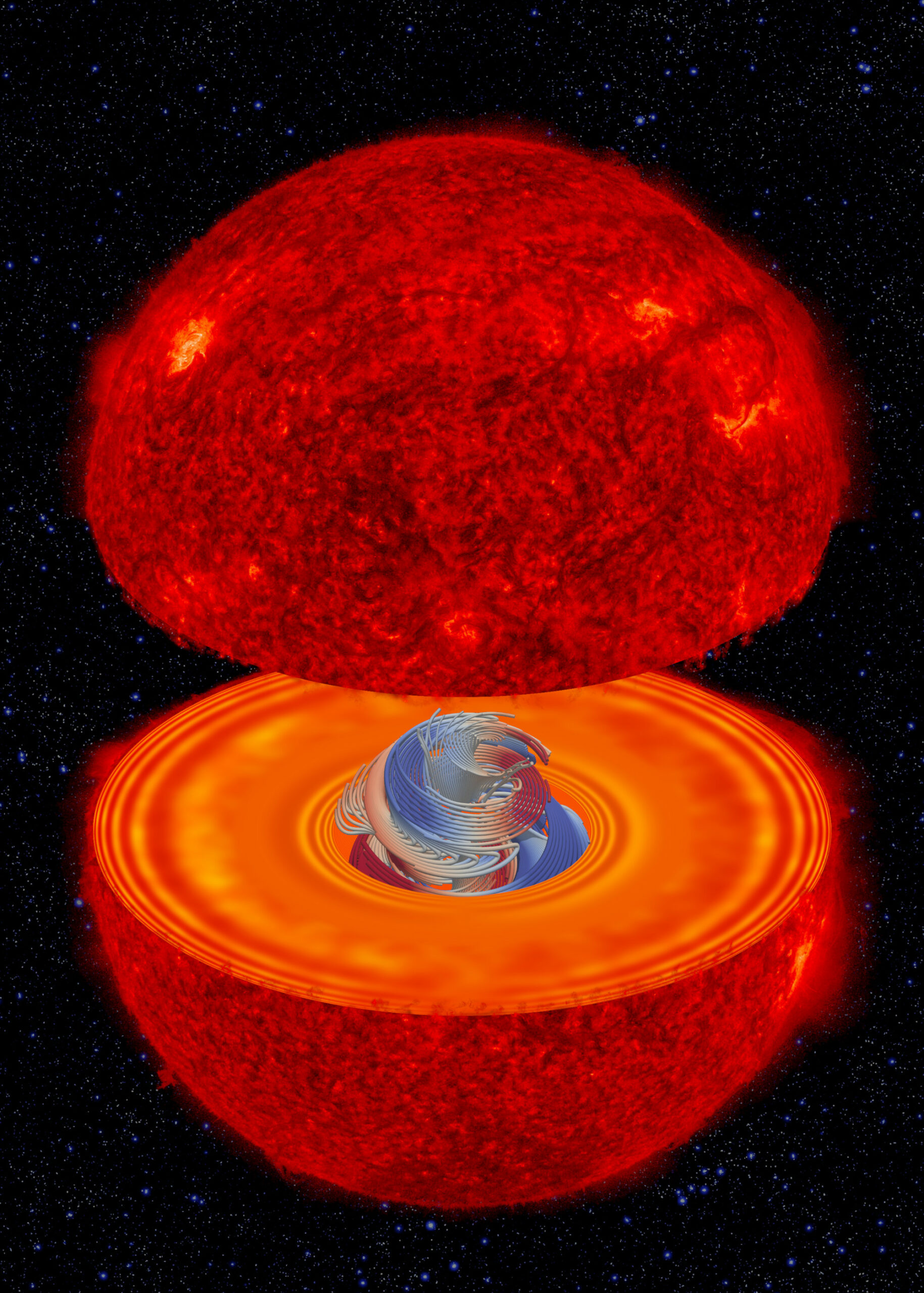
The detection of the magnetic field signature in the oscillations of three red giant stars was possible thanks to data from the Kepler satellite. Magnetic field strengths at the core of these celestial objects have been measured, ranging from 10 to 130 kilogauss, that is to say about 100 000 times more than the average magnetic field at the surface of the Sun. These first measurements were as expected as they were unexpected. “We knew that a magnetic field should slightly modify the frequency of oscillations,” says Sébastien Deheuvels, lecturer at the University Toulouse III – Paul Sabatier and co-author of the publication, “but as this variation depends on the intensity of the field and we had no idea of its properties at the heart of stars, we could not know if this detection would ever take place.”
To reach these results, astrophysicists have identified three red giant stars whose oscillation modes show anomalies. In the general case, the rotation of the star separates each oscillation mode into several components that are regularly spaced in frequency. For the three red giant stars in question, these frequency spacings are irregular: they show strong asymmetries. Thanks to a theoretical analysis, the authors of the study have shown that these asymmetries correspond in every way to those expected in the presence of a strong magnetic field which disturbs the gravity waves in the core of the star. It was thus possible to measure the intensity of the magnetic field and to obtain information about its geometry.
These results open the way to the characterization of the internal magnetic fields of stars and to their integration into stellar evolution models. As Sébastien Deheuvels points out, “without observational constraints on the intensity and topology of the internal magnetic field of stars, the modeling of the effects of the magnetic field would have remained very hypothetical. Seismic measurements of the field will therefore be essential to progress in our understanding of the evolution of stars.” With, in the long-term, the opportunity to build models of stars predicting with a greater reliability the stellar ages, which is a necessity to understand the formation of planetary systems and the evolution of our galaxy.
Further Resources
- Scientific paper : Magnetic fields of 30 to 100 kG in the cores of red giant stars, par Gang Li, Sébastien Deheuvels, Jérôme Ballot, and François Lignières, Nature (2022) – DOI : 10.1038/s41586-022-05176-0.
IRAP Contacts
- Gang Li, gang.li@irap.omp.eu
- Sébastien Deheuvels, sebastien.deheuvels@irap.omp.eu
- Jérôme Ballot, jerome.ballot@irap.omp.eu
- François Lignières, francois.lignieres@irap.omp.eu