
An update to the largest catalogue of X-ray detected astrophysical objects
The first of June sees the seventh data release of the XMM-Newton serendipitous source catalogue (3XMM-DR7), the largest catalogue of X-ray sources ever created. This new version includes 727790 X-ray detections which relate to 499266 unique sources, where some of these sources have been detected as many as 59 times and their evolution can therefore be followed from 2000 until 2016.
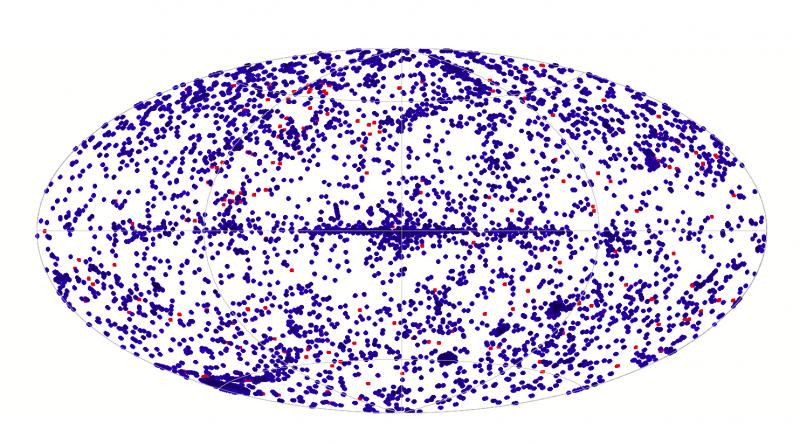
Sources that are bright in X-ray light are amongst the most energetic in the Universe and include matter swirling around black holes, explosions of the most massive stars known, magnetic events on stars, hot gas churning around in the centre of galaxy clusters and even aurora events on other planets in our Solar System. All these objects have been detected with the European Space Agency’s highly sensitive XMM-Newton X-ray observatory, which can detect hundreds of X-ray sources in a region of the sky that is the same size as the full moon in a single observation. The whole catalogue covers more than a thousand square degrees on the sky.
Whilst a part of the catalogue includes known astrophysical objects, the rest comprises objects that are still unstudied. There is therefore plenty of scope to discover new and even exotic objects by studying the catalogue and its many products, which includes images and other scientific data such as lightcurves (the variability of the source with time) and spectra (the amount of X-ray light at different energies). The catalogue can also be used for studying whole populations of objects or just individual sources.
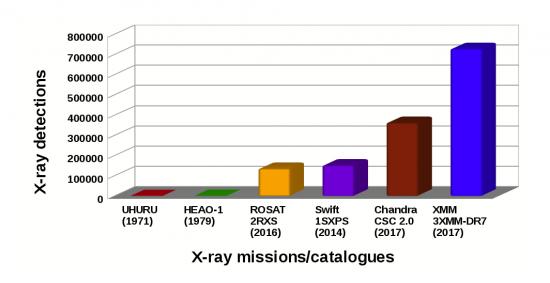
The catalogue is produced by the XMM-Newton Survey Science Centre (SSC), led by Dr. Natalie Webb at IRAP. The SSC is a consortium of the following institutions:
- Institut de Recherche en Astrophysique et Planétologie, Toulouse, France
- Observatoire Astronomique de Strasbourg, France
- Service d’Astrophysique, CEA/DSM/IRFU, Saclay, France
- Leibniz-Institut for Astrophysics Potsdam (AIP), Germany
- Max-Planck Institut für extraterrestrische Physik, Garching, Germany
- University of Leicester, United Kingdom
- Mullard Space Science Laboratory, University College London, United Kingdom
Further Resources
- The XMM-Newton Survey Science Centre webpages and catalogue access: http://xmmssc.irap.omp.eu/
- The paper describing the catalogue: ‘The XMM-Newton serendipitous survey VI. The third XMM-Newton serendipitous source catalogue’, S. R. Rosen, N. A. Webb, M. G. Watson et al., A&A, 590, 1
IRAP Contact
- Dr Natalie Webb, XMM-Newton Survey Science Centre director, Institut de Recherche en Astrophysique et Planétologie, Toulouse, France, Email : Natalie.Webb@irap.omp.eu