
Selection by the European Space Agency of the Comet Interceptor mission with two electron analyzers from IRAP !
The Comet Interceptor mission has been selected by the European Space Agency as its first Fast class mission for its Cosmic Vision programme. Comet Interceptor will be the first space mission to :
(i) explore a dynamically new comet or, with a smaller probability, an interstellar object
(ii) explore the environment of a comet from a multi-point perspective.
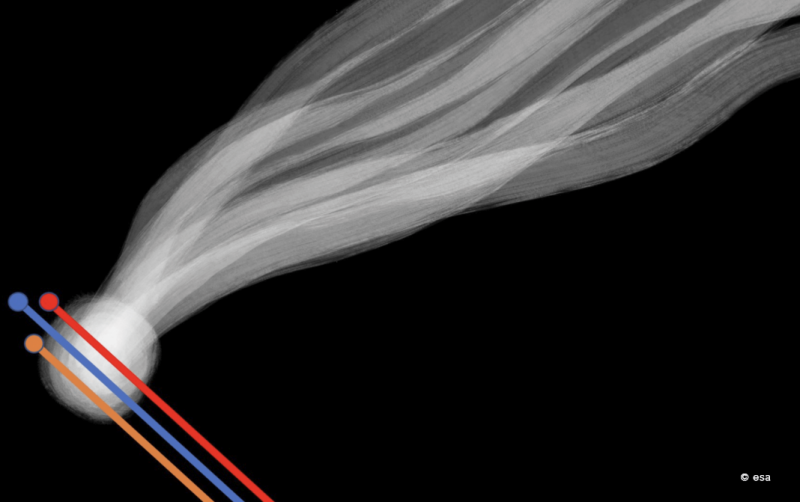
The Comet Interceptor mission will include three spacecraft :
- a mother spacecraft
- two daughter spacecraft
that xill be launched towards the Lagrangian point L2 until ground-based observatories will identify the arrival of a new comet or interstellar object with a trajectory that can be intercepted by Comet Interceptor.
The european contributions will be emabarked onboard the mother spacecraft as well as onboard one of the daughter spacecraft, whereas the second daughter spacecraft will be provided by japanese. French contributions from LPC2E and IRAP are part of the Dust, Field and Plasma consortium that is devoted to measurements of the ionised and dust matter from the comet, as well as its electromagnetic environment and its interaction with the solar wind. IRAP will build two miniaturized electron spectrometers for the mother spacecaraft and one of the daughter spacecraft in order to identify and measure the main sources of ionisation of the cometary neutral gas.
IRAP Contact
- Nicolas André, nicolas.andre@irap.omp.eu