
ESO signs agreement for MOSAIC instrument on the ELT
Today, ESO has signed an agreement with a large international consortium for the design and construction of the Multi-Object Spectrograph (MOSAIC), an instrument for ESO’s Extremely Large Telescope (ELT). Able to measure the light from more than two hundred sources at the same time, MOSAIC will be used to trace the growth of galaxies and the distribution of matter from the Big Bang to the present day.
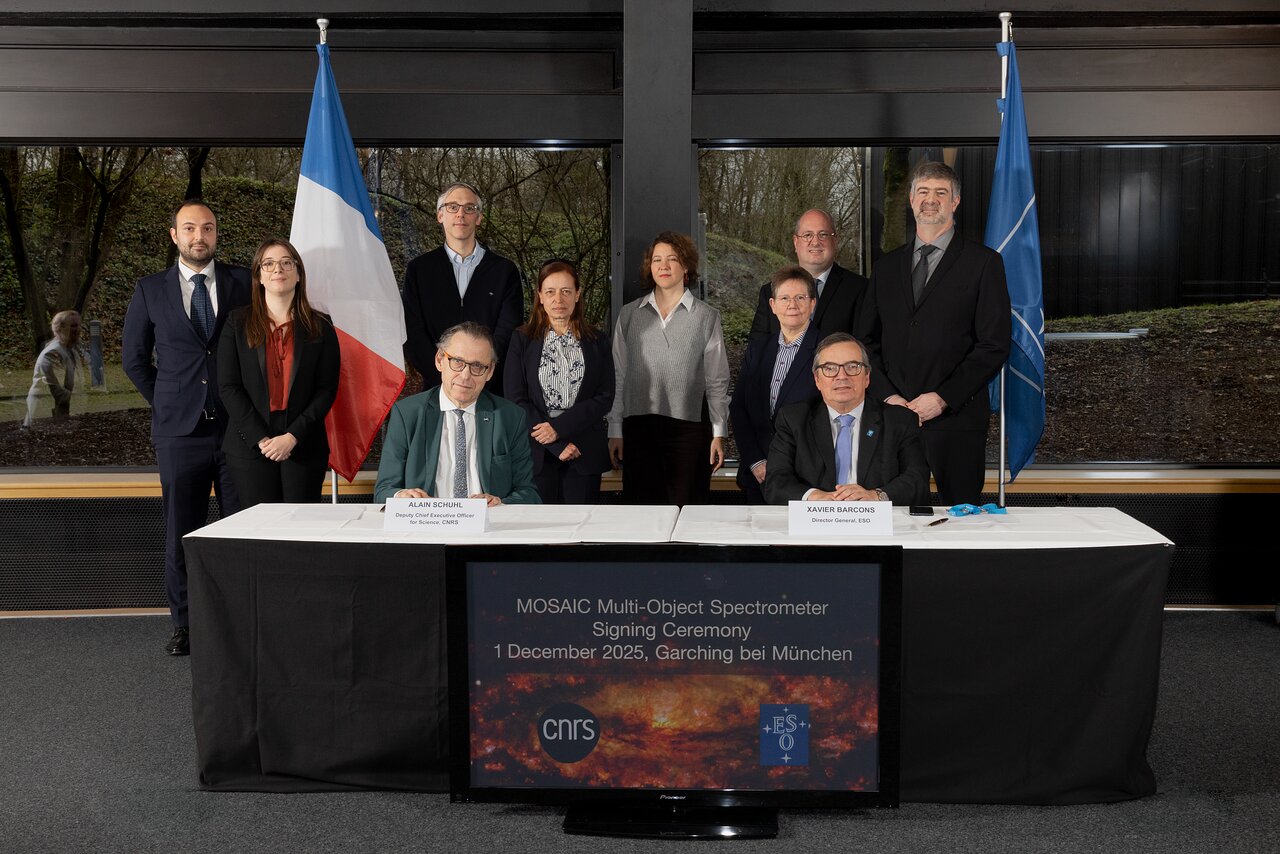
The agreement was signed by ESO’s Director General Xavier Barcons and Alain Schuhl, the Deputy CEO for Science at the French National Centre for Scientific Research (CNRS), the institution leading the MOSAIC consortium. Also in attendance were the MOSAIC Principal Investigator Roser Pello from Marseille Astrophysics Laboratory and Co-Principal Investigator Mathieu Puech from the Paris Observatory, in addition to other dignitaries from ESO, CNRS and the MOSAIC consortium [1]. The signing took place at the ESO Headquarters in Garching, Germany.
MOSAIC is a powerful spectrograph, an instrument that splits light into its component wavelengths so astronomers can determine important properties of astronomical objects, such as their chemical composition or temperature. The instrument will use the widest possible field of view provided by the ELT, operating in both visible and near-infrared light, and will be able to analyse the light for more than two hundred objects simultaneously.
MOSAIC will conduct the first exhaustive inventory of matter in the early Universe, lifting the veil on how matter is distributed within and between galaxies and greatly advancing our understanding of how present-day galaxies formed and evolved. It will also be able to take a close look at the gas surrounding galaxies and identify the chemical elements within it.
ESO’s ELT is currently under construction in Chile’s Atacama Desert, a unique place on Earth to observe the skies. When it sees first technical light later this decade, the ELT will revolutionise what we know about our Universe and make us rethink our place in the cosmos.
IRAP Contacts
- Thierry Contini, thierry.contini@irap.omp.eu
- Marie Larrieu, marie.larrieu@irap.omp.eu