
MACIV nodes: an exceptional seismological network on the volcanoes of the Massif Central
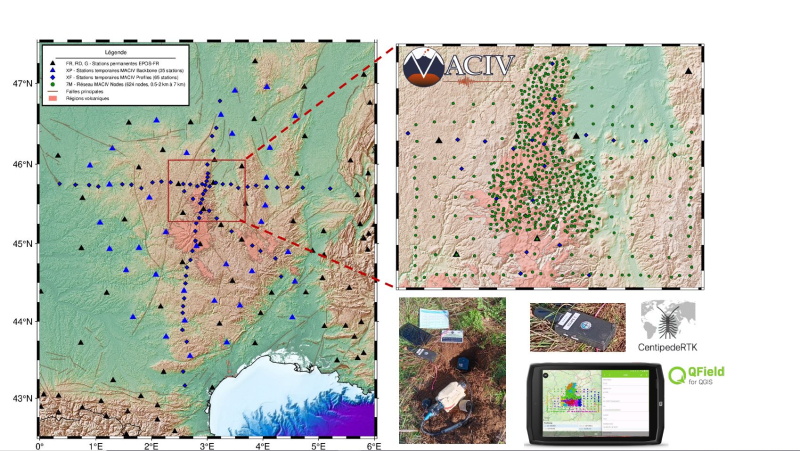
As part of the MACIV project, funded by the French National Research Agency (ANR), a team of scientists deployed the largest mobile seismological network ever installed by a university team in September 2025. This exceptional array of 624 sensors, covering an area of 80 x 100 km² in the heart of the Massif Central, aims to provide detailed images of volcanic systems between 0 and 10 km deep.

From September 15 to 24, 2025, fourteen engineers, doctoral students, and researchers from various laboratories installed this network. Comprising 624 sensors spread over an area of 80 × 100 km², this device aims to image the potentially active volcanic systems of the Massif Central, such as the Chaîne des Puys and the Monts-Dore, whose last eruptions date back less than 10,000 years.
A groundbreaking campaign to probe deep into the Earth
Installed in just 7.5 days, the sensors will record ground movements until they are retrieved after one month. This ultra-dense antenna will provide a detailed image of volcanic systems between 0 and 10 km deep. It complements the permanent broadband networks of RLBP – Epos-France, and temporary networks using instruments from the SisMob – Epos-France park.
Thanks to ISTerre’s geophysical instrumentation service, a new technological milestone has been reached in experimental seismology with the development of innovative methods for geolocation and automatic metadata retrieval. These data will contribute to a better understanding of the sources of intraplate volcanism in the Massif Central and to refining the characterization of regional seismicity.
By the end of October 2025, 621 of the 624 instruments had been recovered in less than a week by six teams of two people.
CNRS Laboratories involved
- Institut des sciences de la Terre (ISTERRE- OSUG) – Tutelles : CNRS / IRD / UGA / Univ. Savoie Mont-Blanc / Univ. Gustave Eiffel
- Laboratoire magmas et volcans (LMV – OPGC) – Tutelles : CNRS / IRD / UCA
- Laboratoire Géosciences environnement Toulouse (GET – OMP) – Tutelles : CNRS / CNES / IRD / Université de Toulouse
- Institut de Recherche en Astrophysique et planétologie (IRAP – OMP) – Tutelles : CNRS / CNES / Univiversité de Toulouse