
An instrument co-developed by a researcher from Toulouse detects record winds at 33,000 km/h on an exoplanet
More than 500 light-years from Earth, wind gusts were flashed at 33,000 km/h on the exoplanet WASP-127b. These are the fastest gusts ever measured on a planet. This technical feat was made possible by a spectrograph co-developed by Alexis Lavail, a researcher at the University of Toulouse’s Institut de recherche en astrophysique et planétologie (IRAP – CNES/CNRS/UT). This breakthrough, published in Astronomy & Astrophysics on January 21, could lead to a better understanding of the climatic and chemical dynamics of planets.
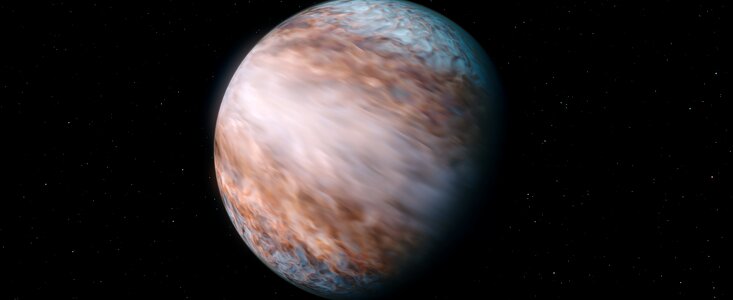
Located 520 light-years from Earth, exoplanet WASP-127b is full of surprises. It is a gas giant, slightly larger than Jupiter but much less massive, with the particularity of orbiting in close proximity to its star: it is closer to it than Mercury is to the Sun in our solar system. “Temperature differences between the poles and sides of the exoplanet, during its mornings and evenings, suggest sophisticated climate dynamics,” explains Alexis Lavail.
Its complex atmosphere made it a subject of interest for astronomers, who were able to measure winds of up to 33,000 km/h. On Earth, the strongest wind gust ever recorded was 80 times less powerful (407 km/h). In our solar system, the fastest winds are those of Neptune, measured at over 1,700 km/h (18 times less powerful than those of WASP-127b).
This discovery was made possible by the CRIRES+ instrument installed on the Very Large Telescope (VLT) at the European Southern Observatory (ESO) in Chile. “It’s one of the best instruments in the world for characterizing the atmospheres of exoplanets,” explains the Toulouse-based astronomer, who was involved in the design and scientific operation of CRIRES+. “It’s a spectrograph in service since the end of 2021 that enables very fine analysis of light in the near-infrared.” When WASP-127b passes in front of its star, the latter’s light passes through the exoplanet’s atmosphere, which “imprints” a signature on it before reaching the spectrograph. The molecules present in the atmosphere absorb light differently, retaining certain wavelengths to the detriment of others. It is from these light signatures that the spectrograph can deduce the exact composition of WASP-127b’s environment.
The scientists involved in the study identified the presence of water vapor and carbon monoxide. For Fei Yan, co-author of the study and professor at the University of Science and Technology of China, “this shows that the exoplanet has complex weather patterns, just like Earth and other planets in our system.” However, the scientists found a shift in the spectrum of the absorption lines of water and carbon monoxide molecules, allowing them to deduce that they are blown by powerful winds.
“It’s the very good resolution of the instrument combined with the telescope’s large diameter that enables us to detect molecules in exoplanet atmospheres and study their dynamics,” explains Alexis Lavail.
Calculations indicated that the molecules were moving at a speed of 9 km/s, or 33,000 km/h on either side of WASP-127b’s equator. These observations are similar to those of jet streams on Earth, but on a much larger scale.
This breakthrough underlines the progress made in the study of exoplanets, thanks to which scientists can now explore in detail the climates and atmospheres of these distant worlds. These results open up new perspectives on understanding the mechanisms of planet formation and climatic processes in our own solar system. In the future, new telescopes such as ESO’s Extremely Large Telescope and its ANDES instrument will enable us to continue this research and analyze smaller, rocky exoplanets with even greater precision.
Further Resources
- Scientific Publication : CRIRES+ transmission spectroscopy of WASP-127 b, by L. Nortmann, F. Lesjak, F. Yan, D. Cont, S. Czesla, A. Lavail, A. D. Rains, E. Nagel, L. Boldt-Christmas, A. Hatzes, A. Reiners, N. Piskunov, O. Kochukhov, U. Heiter, D. Shulyak, M. Rengel and U. Seemann
Astronomy & Astrophysics, janvier 2025 - Podcasts :
IRAP Contact
- Alexis Lavail, alexis.lavail@irap.omp.eu