
Solar Orbiter discovers a new type of fast solar wind
Studying data from ESA’s Solar Orbiter space mission, a research team has discovered a new type of solar wind that challenges our understanding of the acceleration mechanisms of these streams of charged particles emitted by our star. This major discovery has just been published in the journal Astronomy & Astrophysics.
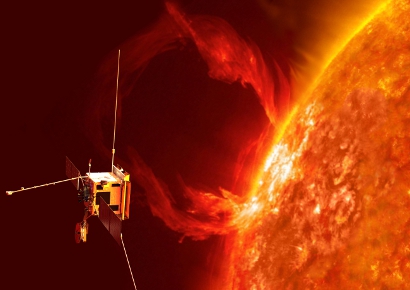
Copyright: ESA/AOES
Using data from the Solar Orbiter mission, a CNRS Terre & Universe research team has identified this fast-moving solar wind with unexpected properties. The results call into question many certainties about solar wind acceleration mechanisms.
It all begins in the Sun’s lower atmosphere, where magnetic field lines – known as “open” – delimit flux tubes that act as conduits for the solar wind. As we move away from the Sun, these tubes gradually widen. However, this widening of the open lines is much more pronounced in the upper solar corona, due to the disappearance with altitude of the so-called “closed” field lines, whose two feet are anchored to the Sun’s surface, and which by their absence leave large “empty” regions in the solar atmosphere that are filled by the open lines: this is known as super-expansion. Until now, scientists have considered this phenomenon only as a factor of strong wind slowdown, mainly due to the fact that enlarging the diameter of an outflow slows down the speed of the fluid flowing through it, leading naturally to slow wind, and therefore without thinking that it could play a role in accelerating the fast solar wind.
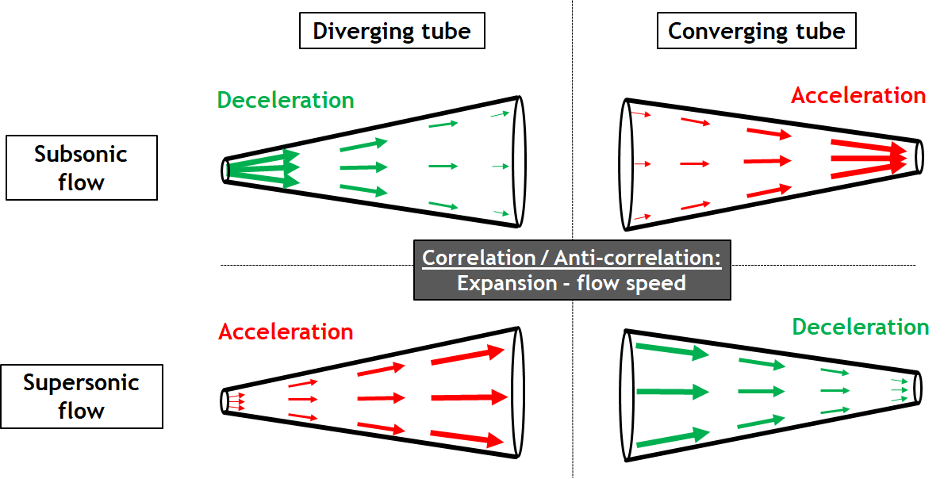
And yet… By estimating the origin of the solar wind observed by Solar Orbiter over a period of a year and a half, the existence of a fast wind originating from these regions of very high expansion has been clearly demonstrated. To explain this phenomenon, the researchers put forward the hypothesis that the Laval nozzle effect (1) is at work in the formation of this newly observed type of fast wind. This discovery opens up new perspectives, both for our fundamental understanding of the mechanisms involved in the formation and acceleration of fast solar winds, and for the improvement of prediction models. The latter play a crucial role in anticipating the evolution of solar flares which, during periods of high solar activity, can seriously disrupt our terrestrial magnetic field and telecommunications.
Note
(1) The Laval nozzle effect – a physical principle found in rocket engines and steam turbines, among others – describes how a fluid can be accelerated beyond the speed of sound by passing through a duct that first narrows before widening.
Further Resource
- Scientific Publication : Testing the Flux Expansion Factor – Solar Wind Speed Relation with Solar Orbiter data. Astronomy & Astrophysics (2024) https://doi.org/10.1051/0004-6361/202451272
IRAP Contact
- Jean-Baptiste Dakeyo, dakeyo@irap.omp.eu