
A recent study reinforces the validity of the standard model in cosmology
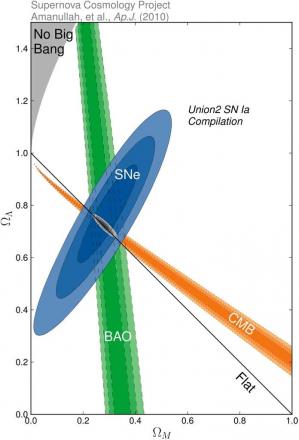
A recent study led by four IRAP researchers and published within the Physical Review has shown that the standard model perfectly accounts – and far better than any other model – for the three sets of observational data that cosmologists presently have: the apparent luminosity and the spectral shifts of a set of 740 supernovae of type Ia, the fossil radiation measurements made by WMap and Planck, and finally those concerning the acoustic oscillations of baryons.
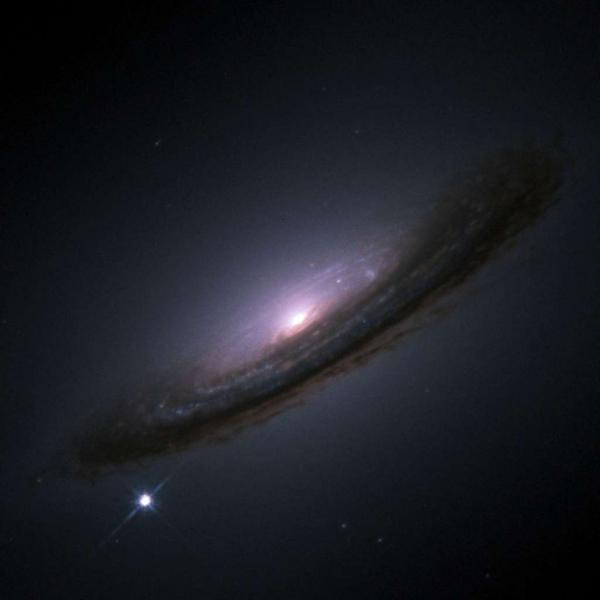
The Hubble diagram of supernovae (SNIa) led to the inclusion of dark energy as the main component of the density of the present universe. This discovery earned the author the Nobel Prize in Physics in 2011. However, recently alternative models, such as the one proposed by Fulvio Melia, have been proposed which, according to their authors, sometimes lead to an equally convincing Hubble diagram, but without necessarily resorting to accelerated expansion. Subir Sarkar and his colleagues recently drove this point home by publishing an article in the journal Scientific Reports, part of the Nature group, which concluded that with a new statistical approach, the Hubble diagram finally provided only a ‘marginal indication’ of acceleration (an article that received a fairly notable echo beyond the circle of specialists). This assertion is all the more true since the possible evolution of supernovae on cosmological time scales is difficult to reject and would remove any hope of using supernovae as a diagnostic of acceleration. But in fact, in almost twenty years the Cosmic Microwave Background (CMB) data and measurements of galaxy distribution, especially with the presence of the “BAO peak”, have provided a much stronger basis for the standard model. A study conducted by Isaac Tutusaus at IRAP within the COBESIX project of the OCEVU lab has just been published in Physical Review D which shows how none of the proposed alternatives can account for the three sets of cosmological observations (SNIa, CMB, BAO) with a quality comparable to the standard model.
Further Resources
- Research article : “Power law cosmology model comparison with CMB scale information” by Isaac Tutusaus et al.
- Interview given by Alain Blanchard to Futura-Sciences on November 8, 2016 : Des doutes sur l’existence de l’énergie noire ?
IRAP Contact
- Alain Blanchard, alain.blanchard@irap.omp.eu