
Plasma Observatory selected as ESA M7 mission
Following the recommendation of the Science Programme Committee (SPC) of the European Space Agency (ESA), ESA Member States have selected Plasma Observatory [1] as the Agency’s first medium-class mission to be implemented under the ESA Voyage 2050 Science Programme [2].
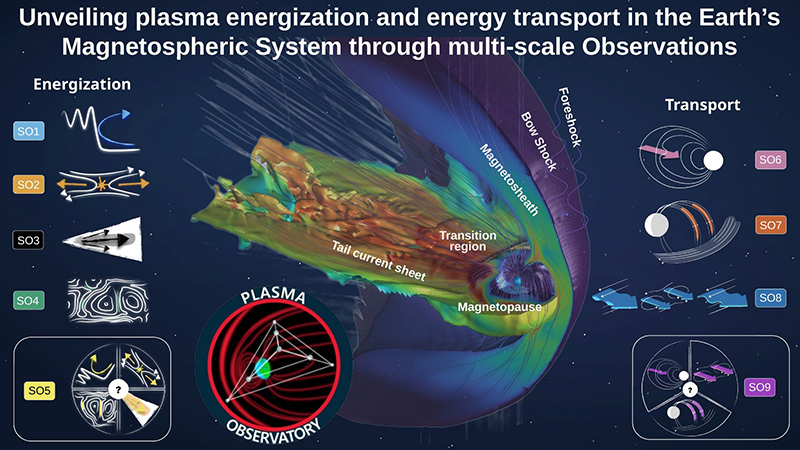
The Plasma Observatory mission will make transformative advances in two major challenges of fundamental plasma physics: understanding how plasma is energized [3] and how energy is transported across space plasmas [4]. To achieve this, the mission will perform, for the first time, three-dimensional, multi-scale measurements throughout the Earth’s Magnetospheric System. This will be accomplished using a constellation of seven identical, spinning spacecraft (Sister SpaceCraft) in highly elliptical Earth orbits. Each spacecraft will carry out advanced measurements of particle distribution functions and electromagnetic fields simultaneously at fluid and ion-kinetic scales, across the key regions of the magnetosphere: the foreshock, bow shock, magnetosheath, magnetopause, magnetotail current sheet and transition region [5].
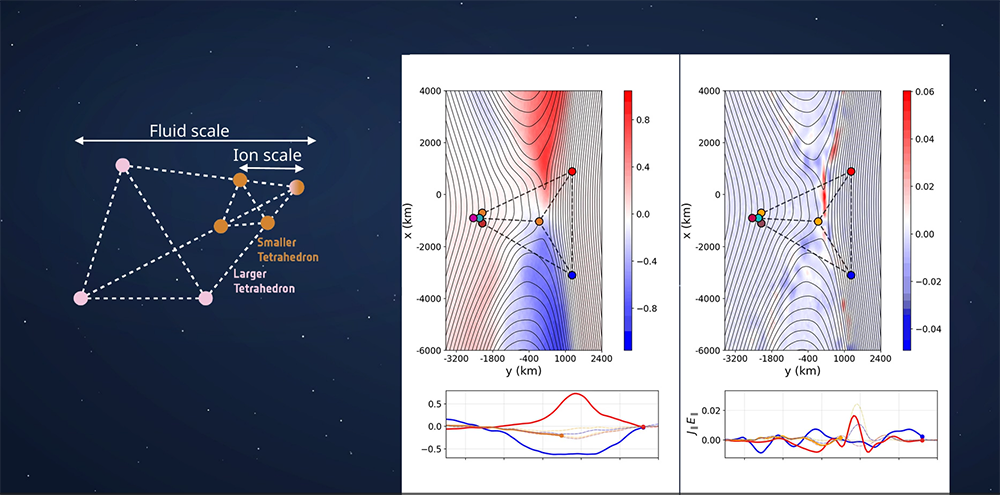
IRAP will contribute in two ways to the Ion-Electron Plasma Camera (iEPC) instrument, led by the LPP and supported by CNES [6]. Firstly, by supplying the high-voltage power supply (HVPS) and, secondly, by carrying out ion and electron calibration of the instrument’s EM and FM models in its CALIPSO 1 test facility. IRAP will also take advantage of this mission to confirm its expertise in the design of high-voltage optocouplers, by innovating with a new epoxy-encapsulated technology, with the aim of raising its TRL level, currently at 5. The high-voltage power supply designed by IRAP builds on the legacy of the Solar Orbiter, JUICE, Comet Interceptor and Heliowarm missions, as well as R&T work on optocouplers funded by CNES. Drawing on this legacy, IRAP can rely on its silicone-encapsulated optocoupler technology, which will serve as a reference model for the flight.The pair of plasma cameras, to be flown on each of the seven Sister SpaceCraft, combines a novel, game-changing electrostatic optical design using innovative 3d-printing technology with an advanced ASIC-based plasma imaging detection system. It will measure three-dimensional distribution functions of thermal ions and electrons at high time resolution, down to plasma kinetic timescales, while requiring substantially less mass, volume and power than conventional plasma spectrometers. These measurements are essential for quantitatively investigating particle energization mechanisms across multiple spatial and temporal scales.
Plasma Observatory is scheduled to enter Phase B1 in December 2026, with mission adoption expected in early 2030 and launch aboard an Ariane 6.4 launcher from Kourou towards the end of 2038.
Références
[2]https://www.cosmos.esa.int/web/voyage-2050
[3]https://link.springer.com/article/10.1007/s10686-021-09797-7
[4]https://link.springer.com/article/10.1007/s10686-022-09861-w
[6]https://cnes.fr/en/node/2980
[7]https://www.insu.cnrs.fr/fr/SelectionPlasmaObservatory
IRAP Contacts :
V. Génot
O. Chassela

