DELIVERY OF THE FLIGHT MODEL OF THE LEES INSTRUMENT FOR THE COMET INTERCEPTOR MISSION
The flight model (FM) of the Low-Energy Electron Spectrometer (LEES) instrument for which IRAP is responsible was delivered on May, 12 2026 to the Space Research Center (CBK) of the Polish Academy of Sciences in Warsaw. It is now ready for the next step, with a test campaign at suite level!
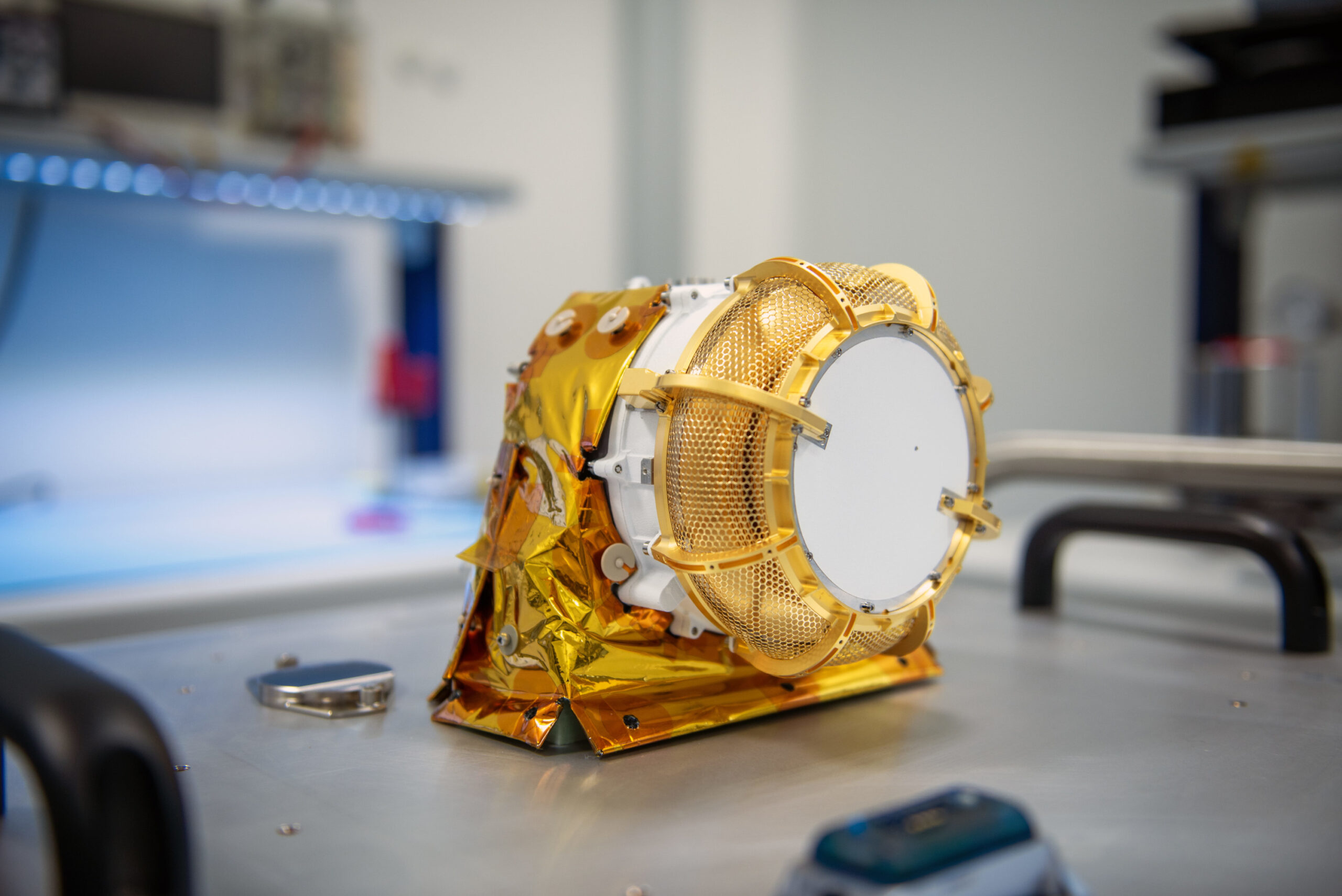
Credit: Sébastien CHASTANET, Observatoire Midi-Pyrénées, Toulouse.
LEES is part of the Dust, Fields, and Particles (DFP) instrumental suite dedicated to multi-point measurements of the ionized and dusty environment of a comet. DFP will measure in particular the magnetic and electric fields, the plasma parameters (density, temperature, speed), the distribution functions of electrons, ions, and energetic neutral atoms, the potential of the satellite, and the impacts of cometary dust in the solar wind and the cometary environment.
LEES is a low-energy electron spectrometer (1 eV-1 keV) designed and built by IRAP with a technical contribution from Charles University in the Czech Republic (provision of the low-voltage power supplies and contribution to the static high-voltage power supplies) and the Astrophysics Laboratory of Bordeaux (provision of mechanical parts). Funding for IRAP and LAB was provided through University of Toulouse, CNRS, CNES, and University of Bordeaux. Funding for Charles University was provided through ESA PRODEX contract.
Further Ressources
- IRAP’s contribution to the Comet Interceptor mission
- The Comet Interceptor mission on the ESA’s website
- Website dedicated to the Comet Interceptor mission
Contacts
- Nicolas ANDRE, Principal Investigator of LEES nicolas.andre@irap.omp.eu & nicolas.andre@isae-supaero.fr
- Christophe VERDEIL, project technical manager for LEES christophe.verdeil@irap.omp.eu
- Lubomir PRECH, Co-Principal Investigator for Charles University Prague, Czech Republic, lubomir.prech@mff.cuni.cz
- Benoit LAVRAUD, Co-I of LEES for Astrophysics Laboratory Bordeaux, benoit.lavraud@u-bordeaux.fr