
The small moon Enceladus sculpts Saturn’s environment over record distances
An international scientific team, including scientists from IRAP and led by LPP, has revealed, using data from the Cassini mission, that the interaction between Saturn and its moon Enceladus is far more extensive and complex than previously thought: Enceladus’s influence extends over a record distance of more than 500,000 km, or more than 2,000 times its own radius. This discovery establishes Enceladus as a giant Alfvén wave generator on the scale of the entire Saturnian system, illustrating how a small moon can shape the environment of a giant planet over record distances.
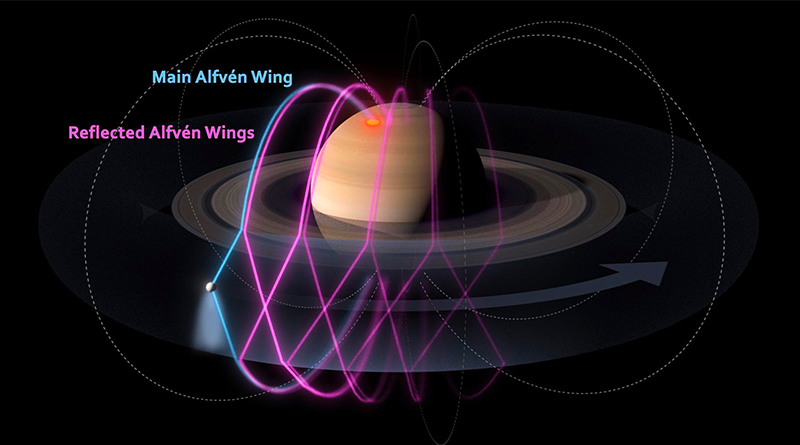
Enceladus, Saturn’s small, icy moon, is famous for its geysers, but its true impact on the giant planet remained partly mysterious. Understanding this interaction is crucial for grasping how energy flows in a planet’s space environment. A study based on data from the Cassini mission now reveals a fascinating discovery: Enceladus’s influence extends over a record distance of more than 500,000 km, or more than 2,000 times its own radius. This finding radically transforms our understanding of the moon.
To achieve this result, the scientific team used wave and particle data from the Cassini spacecraft (NASA/ESA/ASI) accumulated over the mission’s 13 years. Employing a multi-instrumental approach, the scientists were able to identify precise signatures of wave structures commonly known as “Alfvén wings” that propagate along the magnetic field lines on either side of Enceladus. Like an electromagnetic wake, these wave structures form when Saturn’s magnetic field sweeps across Enceladus. Detailed analysis of the data revealed that these waves extend far downstream behind the moon in Saturn’s equatorial plane, reaching not only very high northern latitudes but also very high latitudes in both the north and south.
The major finding shows that the interaction is not limited to the vicinity of the ice plumes, but forms a complex and structured system extending over more than 500,000 km. This phenomenon is explained by the multiple reflections of these Alfvén wings off Saturn’s ionosphere and the boundaries of the plasma torus encompassing Enceladus’s orbit. This is the first time such an extent has been observed, proving that this small moon acts as a giant Alfvén wave generator on a planetary scale. This work opens up unprecedented perspectives for the study of other systems, such as Jupiter’s moons or exoplanets, by showing that a small celestial body can influence its giant host over very long distances, on the order of the host’s own size.
CNRS Laboratories inolved
- Laboratoire de Physique des Plasmas (LPP)Tutelles : CNRS / Ecole Polytechnique / Sorbonne Univ
- Institut de Recherche en Astrophysique et planétologie (IRAP – OMP)Tutelles : CNRS / CNES / Univiversité de Toulouse
- Laboratoire d’astrophysique de Marseille (LAM – OSU Pythéas)Tutelles : CNRS / CNES / AMU
- Laboratoire d’Instrumentation et de Recherche en Astrophysique (LIRA -Observatoire de Paris – PSL)Tutelles : CNRS / Observatoire de Paris – PSL / Sorbonne Univ / Univ Paris Cité
- Laboratoire Atmosphères, Milieux, Observations Spatiales (LATMOS-IPSL)Tutelles : IPSL / CNRS / Sorbonne Univ / UVSQ
This is a study by the LPP, in collaboration with researchers from other laboratories, both national (IRAP, ISAE-SUPAERO, LATMOS, LAM and LIRA/Paris Observatory) and international (IRFU/Sweden, MPS/Germany, CAS/Czech Republic, ESA, APL, UCLA, University of Michigan, Boston and Iowa in the United States, DIAS/Ireland, MSSL/UCL and Imperial College in the United Kingdom).
Further Resources
- Publication scientifique : Hadid, L. Z., Chust, T., Wahlund, J.‐E., Morooka, M. W., Roussos, E., Witasse, O., et al. (2026). Evidence of an extended Alfvén wing system at Enceladus: Cassini’s multi‐instrument observations. Journal of Geophysical Research: Space Physics, 131, e2025JA034657.
- Press Releases
- Scientific paper on the same subject:
- Rabia, J., L.Z. Hadid, N. André et al., Cassini CAPS-ELS Observations of Low-Energy Electron Beams Within Enceladus Mid-Latitude Flux Tubes, Geophysical Research Letters, 2025. https://doi.org/10.1029/2025GL119448
IRAP Contacts
- Nicolas André, nicolas.andre@utoulouse.fr (also at ISAE-SUPAERO, nicolas.andre@isae-supaero.fr)
- Jonas Rabia (now postdoc at IRF Kiruna)