
Westerlund 1: a stellar nursery blows a wind of particles on a galactic scale
An international team of scientists led by Marianne Lemoine, Director of Research at LP2IB, with a contribution from IRAP, has just revealed, for the first time, a stream of particles escaping from a young massive star cluster in our galaxy by combining data from NASA’s Fermi satellite and the H.E.S.S. network of ground-based telescopes, both of which observe gamma rays emitted by astrophysical sources. These results, published in Nature Communications, shed new light on the role of star clusters in accelerating cosmic rays, contributing to the redistribution of matter on a galactic scale and thus to the formation of new stars.
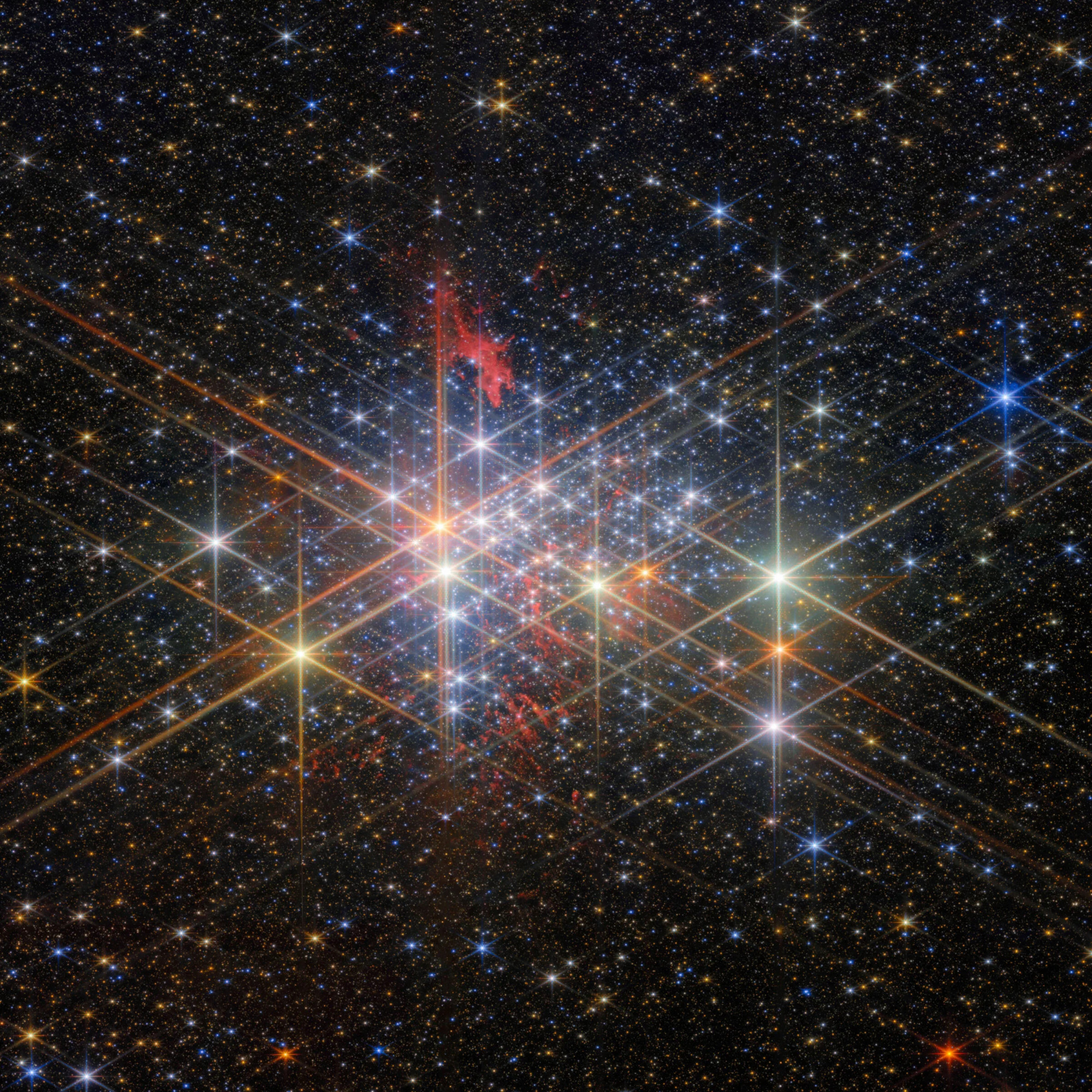
More than 13,000 light-years from Earth, the Westerlund 1 star cluster has been on astrophysicists’ radar for decades. This very young cluster in the Milky Way—barely 4 million years old compared to the Sun’s 4.5 billion years—contains hundreds of massive stars* within a diameter of only six light-years, whose combined power generates a powerful wind of elementary particles: cosmic rays. A collaboration between LP2iB, the Max Planck Institute, and IRAP, based on a combination of data from NASA’s Fermi satellite and the H.E.S.S. ground-based telescope network, has just demonstrated, for the first time, that this cataclysmic particle wind manages to escape from the cluster in the form of a particle stream, which could eventually leave the galactic disk to feed the galactic halo and thus contribute to the chemical evolution of the galaxy.
For three years, we have known that Westerlund-1, which concentrates the mass equivalent of 100,000 suns, acts as a natural particle accelerator contributing to the acceleration of cosmic rays, composed mainly of protons and a small amount of heavier nuclei, but also electrons. The discovery by the H.E.S.S. telescopes in 2022 of gamma radiation encompassing Westerlund-1, with an energy of around teraelectronvolts (TeV), had revealed the presence of electrons accelerated to dizzying speeds at the outer edges of the cluster by the collective magnetic winds of its many massive stars. It is the gamma rays generated by the interaction between electrons and photons in a process called “inverse Compton scattering” that are indirectly detected by the H.E.S.S. telescope network, allowing scientists to deduce the presence of cosmic rays. But one peculiarity intrigued the researchers: this radiation appeared not only as a ring around the cluster, but also as a “tail” extension pointing away from the galactic plane.
“It was in this context that I worked with the Max Planck Institute,” explains Marianne Lemoine, researcher at LP2I Bordeaux and lead author of the article. “They wanted me to study this observation by H.E.S.S. in light of data from the Fermi satellite, which had also observed gamma sources in the vicinity of Westerlund-1. Fermi did indeed detect gamma emissions in the gigaelectronvolt (GeV) range in a region extending well beyond the cluster, up to several hundred light-years away. I then demonstrated that these gamma emissions did not originate from isolated sources but should be understood as a single phenomenon. It is in fact an extension of the gamma radiation detected by H.E.S.S., escaping from the cluster in the form of a stream of particles propagating through interstellar space over more than 500 light-years.
Luigi Tibaldo, Assistant Astronomer at IRAP, drawing on his expertise in Fermi data analysis and the interstellar medium, helped establish the robustness of this result.
Following this analysis, the Max Planck Institute team set about modeling the phenomena at work in this long trail of radiation. According to their model, electrons accelerated at the edges of the cluster are propelled out of it perpendicular to the plane of the galaxy, towards the galactic halo. The most energetic electrons quickly lose their energy and are therefore only visible in the immediate vicinity of the cluster, where they produce the high-energy gamma radiation (in the TeV range) detected by H.E.S.S. Further away from the cluster, only electrons that have already lost some of their energy are detected: these are the ones that give rise to the more diffuse gamma emission observed by Fermi. This modeling of the cosmic ray flux received further confirmation when the study of interstellar gas in this region of the galaxy revealed an area depleted in matter, as if the electron flux had literally blown away the surrounding matter.
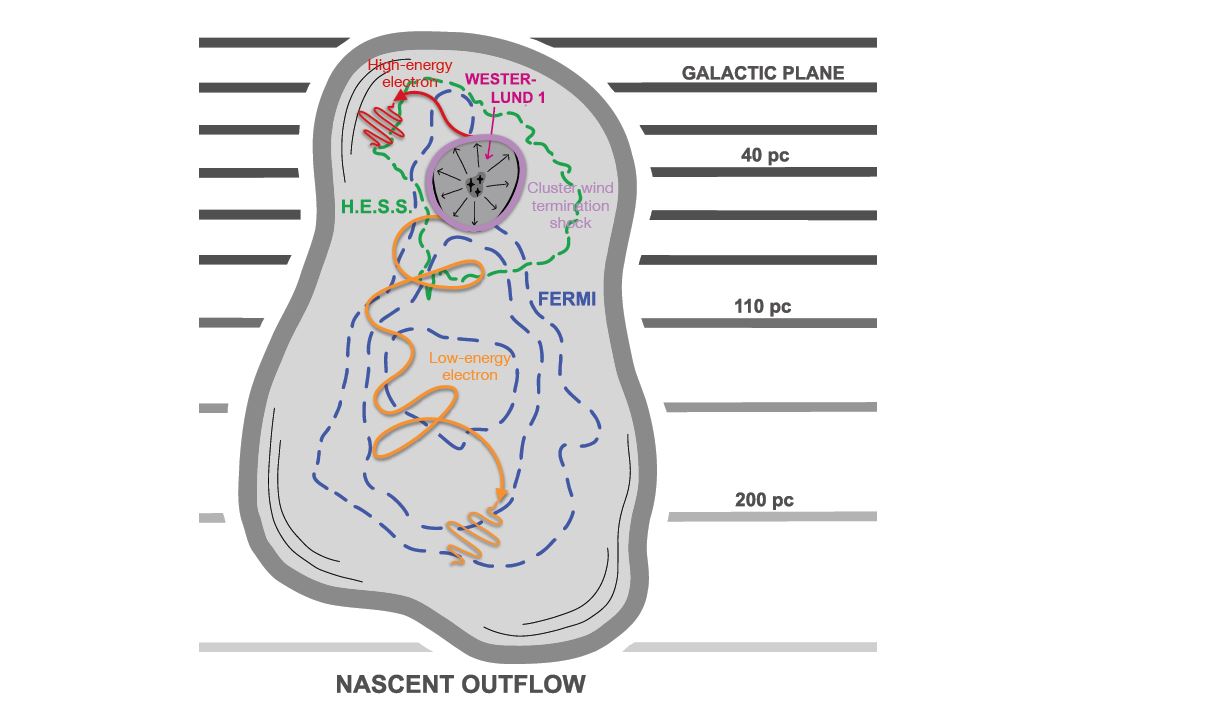
“With H.E.S.S. and Fermi, we can only indirectly detect electrons, which produce gamma rays. Protons remain invisible here because the region around the cluster is very low in matter: protons can only interact with other protons, and without enough targets, they do not produce a detectable signal,” adds Marianne Lemoine. However, it is highly likely that if this stream were to continue spreading to the galactic halo, it would eventually reach other regions of the galactic plane, contributing to the redistribution of matter in the Milky Way and thus to the formation of new stars and new clusters.”
This combined analysis of data from Fermi and H.E.S.S. represents a major step forward in understanding how galaxies regulate themselves and evolve over time. Future observations from the CTAO Observatory, currently under construction in Chile and the Canary Islands, will determine whether Westerlund-1 is a unique case in the galaxy or a representative model of many other massive clusters in the Universe.
*In the vicinity of the Sun, there is on average less than one star in the same volume.
Further Resources
- Scientific article : A cosmic-ray loaded nascent outflow driven by a massive star cluster, M. Lemoine-Goumard et al., Nature Communications 16, Article number: 10820 (2025) https://doi.org/10.1038/s41467-025-65592-4
- Press Review :
- Communiqué de Presse de l’IN2P3
- The leaking star cluster (Max Planck Institüt fur KernPhysik)
- The leaking star cluster (EurekAlert)
- NASA’s Fermi Spots Young Star Cluster Blowing Gamma-Ray Bubbles (NASA)
IRAP Contact
- Luigi Tibaldo, luigi.tibaldo@irap.omp.eu