
Jupiter: natural regulators maintain the balance of its magnetized plasma disk
Around Jupiter, a gigantic disk of magnetized plasma undergoes constant disturbances. How does it maintain its balance? Thanks to the Juno mission, a CNRS Earth & Universe research team has revealed the key role played by instabilities that act as safety valves: they automatically release excess energy to stabilize the system.
Jupiter’s magnetosphere hosts a spectacular structure: a disk of magnetized plasma, called a magnetodisk, which extends across the equatorial plane of the giant planet. This disk is formed from matter ejected by Io, Jupiter’s volcanic moon. Once ionized, this material is transported outward and acts as a veritable energy converter: the magnetodisk transforms Jupiter’s rotational energy into plasma energy. But this system is constantly disrupted by disturbances, ranging from small local instabilities to global magnetic reconfigurations. Despite these turbulences, which have been observed for decades, scientists did not understand how the magnetodisk managed to remain in equilibrium. What state does the plasma evolve into after a disturbance? And above all, how does it dissipate its excess energy?
To answer these questions, researchers used data from the Juno probe, which has been orbiting Jupiter since 2016. They then systematically measured a crucial property of plasma: its pressure anisotropy, i.e., the difference between the pressure perpendicular and parallel to the magnetic field. This measurement, carried out for the first time on this scale using Juno’s JADE and JEDI instruments, makes it possible to diagnose the state of the plasma and predict whether it is likely to trigger instabilities.
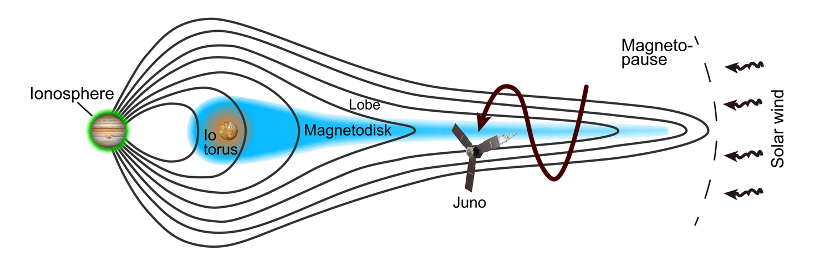
The results are unequivocal. The team discovered that the plasma in the magnetodisk naturally maintains itself in a stable equilibrium zone. As soon as it deviates from this zone by accumulating too much energy, instabilities are spontaneously triggered. These instabilities—technically known as mirror, cyclotron, and firehose—generate waves that redistribute excess energy and return the plasma to a stable state. Juno even detected these fluctuations in action, confirming that the plasma regulates itself by emitting waves. Firehose instability appears to be particularly important: it dissipates the free energy produced during sudden magnetic reconfigurations, notably through a mechanism called Fermi acceleration, where particles gain energy by bouncing between moving magnetic structures.
This research reveals how Jupiter maintains the balance of its space environment despite constant disturbances. These regulatory mechanisms could be at work in other rapidly rotating magnetospheres, such as Saturn’s, and open up new perspectives for interpreting future observations from the JUICE mission, which will study the Jovian system starting in 2031.
Further Resources
- Scientific paper : Liu, Z.-Y., André, N., Blanc, M. et al. Pressure anisotropy-driven instabilities regulate the Jovian magnetodisk. Nature Communications (2025). https://www.nature.com/articles/s41467-025-65064-9
IRAP Contacts
- Nicolas André, nicolas.andre@irap.omp.eu
- Michel Blanc, michel.blanc@irap.omp.eu