
MicroLIBS: a small French instrument with big ambitions for Mars exploration
Following the success of French contributions to NASA’s Mars rovers, CNES and IRAP are developing a miniaturized version of these instruments for future Mars and Moon missions.
If you follow the epic story of Mars exploration, you’re probably familiar with the names ChemCam and SuperCam! Respectively aboard the Curiosity rover (on Mars since 2012) and Perseverance rover (since 2021), these two Franco-American laser instruments are still making progress in Gale Crater and Jezero Crater and analyzing new rocks.
CNES and IRAP, with strong support from the Midi-Pyrénées Observatory (OMP), Los Alamos National Laboratory (LANL), and the German Aerospace Center (DLR), are now developing their successor: a new instrument that is much smaller but just as remarkable in terms of performance. Its name? MicroLIBS. Like its predecessors, it will enable the analysis of a wide variety of surface rocks using LIBS technology.
LIBS, a technique for revealing the composition of rocks
Laser-induced breakdown spectroscopy (LIBS) is a measurement technique used to analyze the chemical composition of rocks from a distance. It can be used to quantify the abundance of the major elements of rocky planets (silicon, iron, magnesium, aluminum, calcium, potassium, sodium, titanium) in addition to volatile elements, as well as other light and/or minor elements such as lithium, boron, hydrogen, and carbon, which are difficult to measure using other techniques.
Mapping rocks at the micro scale
However, its objectives are somewhat different. By covering an area of 1 cm² for each target rock with almost a thousand measurement points on a scale of approximately 100 microns (the diameter of a hair), MicroLIBS will enable the surface components to be characterized in detail. This data is essential for understanding the origin and evolution of many rocks, whether igneous or sedimentary. Suffice it to say that MicroLIBS is eagerly awaited by the scientific community!
One of the ultimate measures for understanding the origin of surface rocks is mapping their micro-scale elements. By combining the chemical composition with the fine components of a rock (crystal assemblages, micro-fracture fillings, sedimentary grains, concretions, and cements), such mapping makes it possible to reconstruct the environments that produced them. MicroLIBS will produce this type of measurement while being small enough to be carried on future exploration missions, which will be much lighter and more mobile. William Rapin, MicroLIBS Scientific Project Manager at IRAP.
Currently being integrated at CNES
MicroLIBS has been designed and developed since 2022 by CNES in collaboration with the IRAP and OMP laboratories (France) and LANL (Los Alamos National Laboratory, United States), long-standing partners of ChemCam and SuperCam. The two-year design phase consolidated the instrument’s technical architecture for new lightweight drone-type platforms, while also considering the necessary adaptations for a future lunar or Martian rover. MicroLIBS is light enough to be used with a Martian drone or hexacopter (a type of drone with six propellers). Such a combination would open up revolutionary prospects for Mars geology by providing access to terrain that is inaccessible to rovers!
The technical challenge is twofold: developing an autonomous targeting system, as MicroLIBS will not benefit from the pointing system found on rover masts, and designing a pulsed power laser weighing less than 150 g, all within a structure the size of a small shoebox, which includes associated electronics, a camera, two spectrometers, and a small telescope. The complete instrument must weigh less than 1.5 kg to be compatible with a Martian hexacopter payload. Charles Yana, MicroLIBS Project Manager at CNES
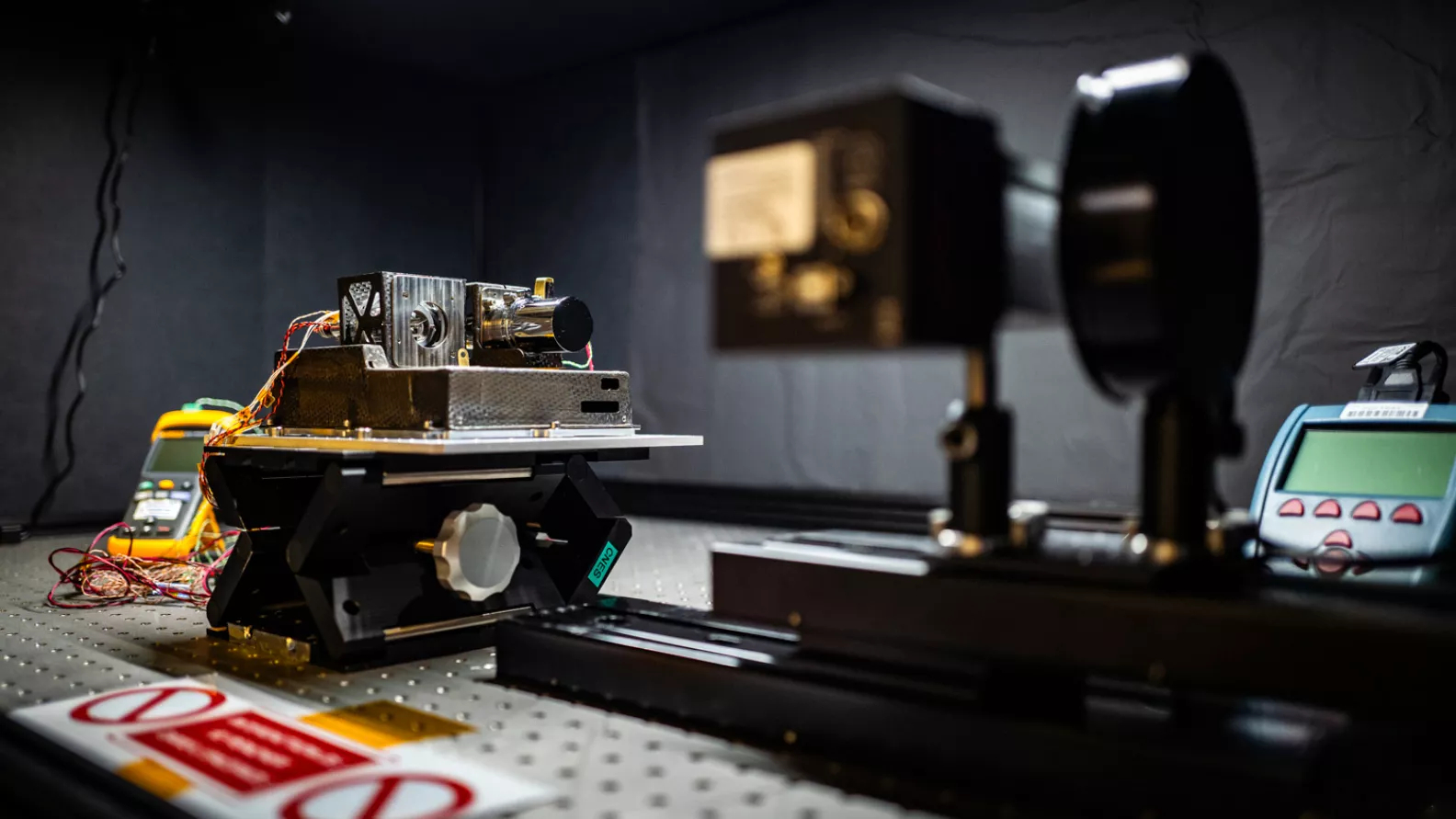
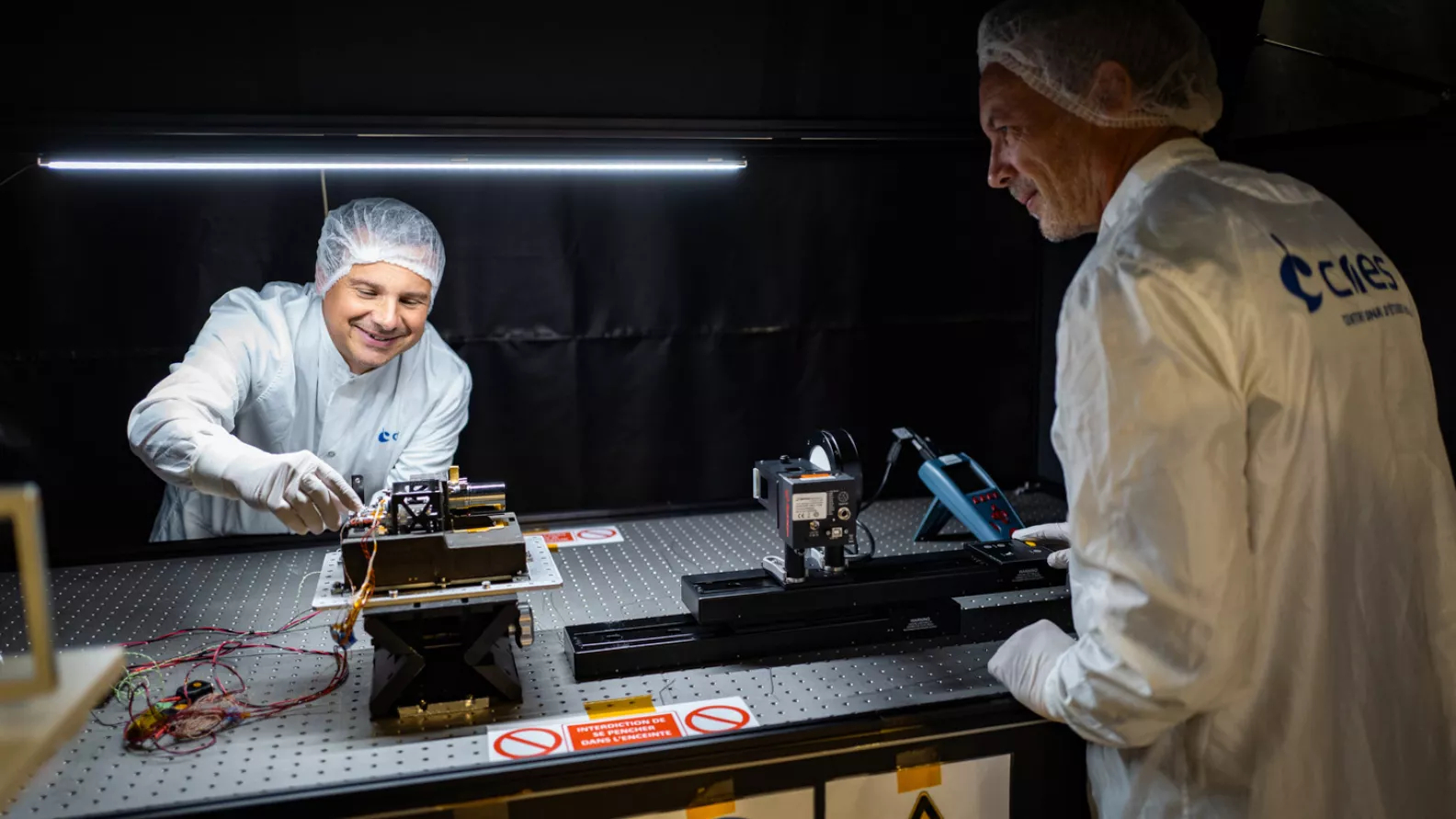
The integration phase for the MicroLIBS prototype began at CNES with the assembly and successive testing of the various subsystems. The first laser firing took place at the very end of September 2025. The goal now is to have a complete and functional instrument by the end of 2025.
IRAP Contact
- William Rapin, william.rapin@irap.omp.eu