
Could Mars have had a tropical climate in the past?
Recent discoveries made by NASA’s Perseverance rover in the Jezero crater on Mars reveal fascinating clues to the history of water and geological activity on the Red Planet.
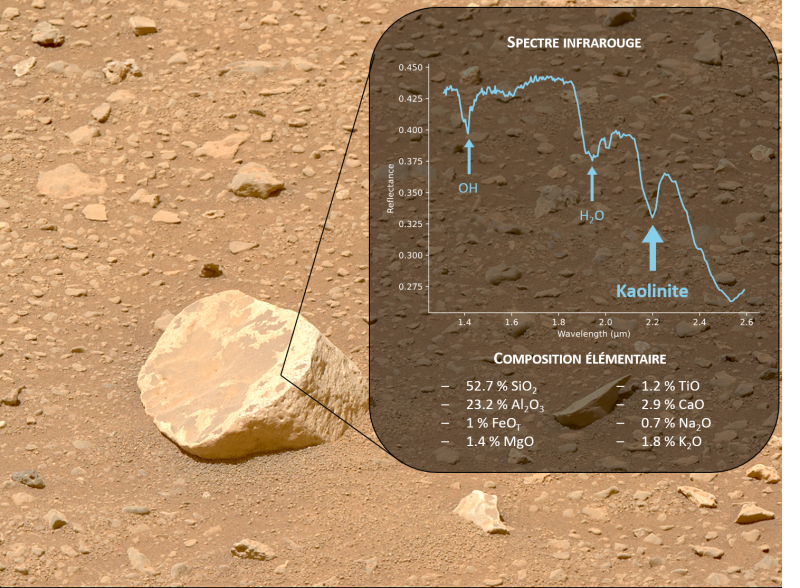
An international research team including scientists from CNRS Terre & Univers and CNRS Physique, has identified clear rocks rich in alumina (Al₂O₃), a compound rarely found in such concentrations on Mars. In particular, these rocks contain minerals such as kaolinite, a clay formed by intense aqueous weathering, and dehydrated phases, including spinel-like minerals.
They testify to extreme weathering by water, probably during the ancient periods of Mars, around 3.8 to 4 billion years ago, when wet conditions prevailed. Water would have dissolved elements such as iron and magnesium, leaving a high concentration of aluminum. Subsequently, these rocks were exposed to high temperatures, perhaps as a result of meteorite impacts or volcanic processes, leading to partial dehydration and hardening.
These rock fragments, scattered around the Jezero crater, may have come from the crater rim, eroded by fluvial phenomena or impacts. Their discovery is significant because kaolinite and other similar clays are markers of a once habitable environment. It demonstrates that Mars underwent complex geological processes comparable to those observed on Earth, and confirms that water played a crucial role in transforming its landscape.
Scientists hope that the study of these rocks will lead to a better understanding of Mars’ ancient climatic conditions, as well as the mechanisms that may have supported possible microbial life. These samples are also considered a priority target for return to Earth on future missions, as they could contain valuable clues to Mars’ geological and climatic history.
In short, these alumina-rich rocks represent the most pronounced signs of aqueous alteration ever observed in-situ on Mars. They shed light on the planet’s wet periods and pave the way for new research into the possibility of past life on the Red Planet.
The SuperCam instrument package
This highly innovative instrument package was developed jointly by a consortium of French laboratories led by IRAP (Toulouse, France) and LANL (Los Alamos, USA), with a contribution from the University of Valladolid (Valladolid, Spain). CNES is responsible to NASA for the French contribution to SuperCam. CNES, CNRS and a number of universities have contributed human resources for the supply of this instrument, and the instrument is operated alternately by the American team from LANL and by the French and European team through the control center installed at CNES in Toulouse (FOCSE Mars 2020).
CNRS Laboratories involved
- Laboratoires du CNRS Terre & Univers :
- Laboratoire Atmosphères, Milieux, Observations Spatiales (LATMOS-IPSL) Tutelles : IPSL / CNRS / Sorbonne Univ / UVSQ
- Institut de Recherche en Astrophysique et planétologie (IRAP – OMP)Tutelles : CNRS / CNES / Univ.Toulouse III Paul Sabatier
- Institut de planétologie et d’astrophysique de Grenoble (IPAG – OSUG)Tutelles : CNRS / UGA
- Laboratoire de Géologie de Lyon : Terre, Planètes, Environnement (LGL-TPE – OSUL)Tutelles : CNRS / ENS Lyon / Univ. Claude Bernard / UJM Saint-Etienne
- Laboratoire d’Instrumentation et de Recherche en Astrophysique (LIRA – Obs de Paris-PSL)Tutelles : CNRS / Observatoire de Paris – PSL / Sorbonne Univ / Univ Paris Cité
- Laboratoire du CNRS Physique :
- Institut de Minéralogie, de Physique des Matériaux et de Cosmochimie (IMPMC)Tutelles : CNRS / MNHN / Sorbonne Univ
Further Resource
- Scientific publication : Royer, C., Bedford, C.C., Johnson, J.R. et al. Intense alteration on early Mars revealed by high-aluminum rocks at Jezero crater. Commun Earth Environ 5, 671 (2024).
IRAP Contact
- Olivier Forni, olivier.forni@irap.omp.eu