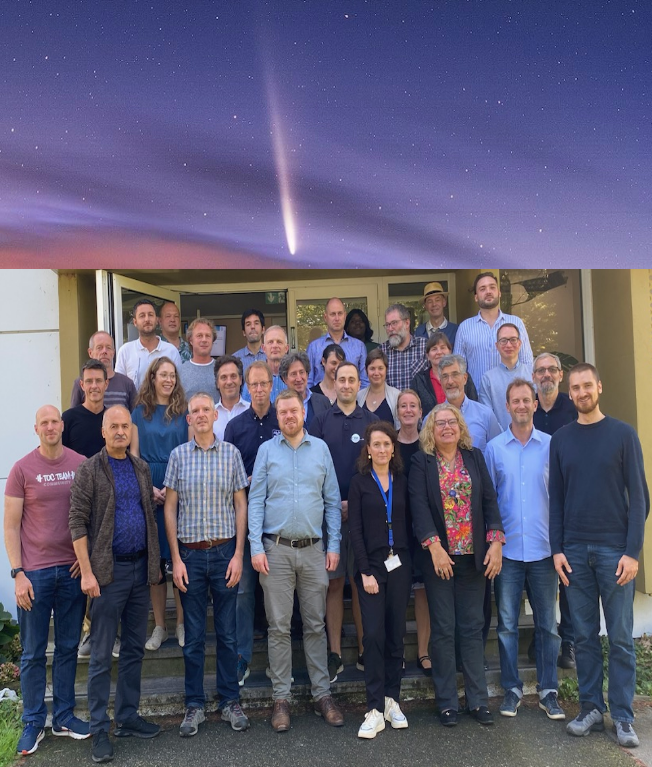
A successful launch (Hera), a bright comet (Tsuchinshan-Atlas), and one year to go before the delivery of IRAP’s electron spectrometer (LEES) for Comet Interceptor!
The annual meeting of the Dust, fields, Particles (DFP) consortium of the Comet Interceptor mission was hosted at IRAP on October 8 and 9. 40 participants from CBK Warsaw (PI), University Charles Prague, IAP Prague, INAF-IAPS Rome, Leonardo Italy, University of Braunschweig, IRF Uppsala, IRF Kiruna, Imperial College London, IWF Graz, LPC2E, LAB, and IRAP attended the meeting. This meeting took place at a very special time for the project, with the successful launch of Hera (from which the Comet Interceptor spacecraft inherits) on October 7, and the pristine comet Tsuchinshan-Atlas (a long-period comet similar to the target of Comet Interceptor) shining in the sky! All good signs for the preparation of the next steps toward the delivery of flight models to DFP in about one year!
IRAP is responsible for the development of the Low-Energy Electron Spectometer (LEES) instrument for the DFP consortium. The LEES STM model will be tested and validated at the end of 2024. The LEES EQM model will be tested and validated in the first semester of 2025. The LEES PFM model will be delivered to CBK in November 2025 at the earliest.
Further Resources
- Nicolas André in video
- SOHO probe films comet Tsuchinshan–ATLAS approaching the Sun
- The contribution of IRAP to Comet Interceptor
- Hera asteroid mission liftoff
IRAP Contacts
- Nicolas André (IRAP, ISAE-SUPAERO), nicolas.andre@irap.omp.eu, nicolas.andre@isae-supaero.fr
- Christophe Verdeil, christophe.verdeil@irap.omp.eu