
The standard cosmological model remains solid on its foundations
To describe the physical rules that govern the functioning of the observable universe, the scientific community uses the Standard Cosmological Model to represent it as accurately as possible. However, some recent data have come into conflict with this model, making it less accurate. A team from the Institut de recherche en astrophysique et planétologie (IRAP-OMP – CNES/CNRS/UT3) has recommended a new approach to the standard cosmological model, making it more reliable.
The Standard Cosmological Model (noted ΛCDM for lambda – cold dark matter), which is widely accepted by cosmologists, has in recent years come up against tensions with some recent cosmological data. One stumbling block concerns the value of the Hubble constant, which measures the speed at which the universe is expanding. Direct measurements of the constant obtained from local distance scales don’t quite match the values obtained from the cosmological microwave background (CMB). In addition, there are concerns about the magnitude of the variations in the density of matter in the universe: the variations, or “fluctuations”, in the density of matter estimated in the local universe appear to be smaller than those expected from CMB measurements, which concern the universe at 370,000 years of age.
These problems have led to the exploration of a large number of alternative models, numbering around 200. The IRAP team, led by Alain Blanchard, Professor at Toulouse III – Paul Sabatier University, presents a new approach to reconciling these tensions in the Standard Model. By combining several recent measurements from different methods to obtain precise constraints on current matter density, the revisited Standard Cosmological Model addresses the dissension around matter fluctuations in the universe, in agreement with the values obtained from the cosmological background measured by the Planck satellite.
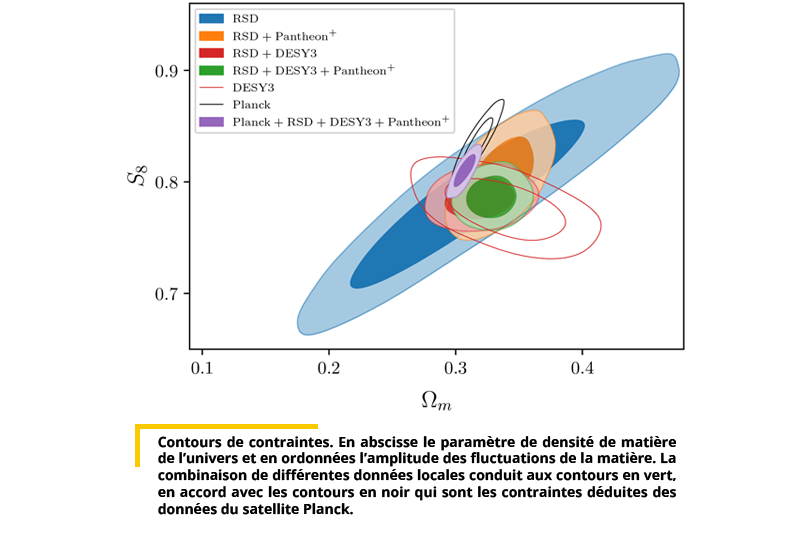
To solve the tension concerning the Hubble constant, scientists suggest that some of the measurements of this constant may be biased. By treating this possible bias as a parameter in the ΛCDM model, this extension of the model is examined on the same statistical basis as alternative cosmological models that attempt to explain the value of the Hubble constant.
As a result, this new version proposed by Alain Blanchard’s team is preferred to all the other alternative models proposed. It is statistically equivalent to or better than previously proposed unbiased extensions, for which such a comparison can be made.
Further Resources
- Scientific article : ΛCDM is alive and well by Alain Blanchard, Jean-Yves Héloret, Stéphane Ilić, Brahim Lamine, Isaac Tutusaus, Cosmology and Nongalactic Astrophysics, mai 2024
- Press Release of the Université de Toulouse III
IRAP Contact
- Alain Blanchard, alain.blanchard@irap.omp.eu