
A new way to understand plate tectonics: olivine glass
The separation between the rigid lithosphere and the ductile asthenosphere is a major mechanical discontinuity of the globe. This boundary is characterized by a five-order drop in viscosity generally associated with the temperature range 1300-1400 K. It is the key to the mechanical coupling between the underlying asthenospheric convection and the horizontal movements of the lithospheric plates, yet its origin is still uncertain. A new study, carried out within the framework of the ERC TimeMan, addresses this question from the perspective of the mechanical properties of olivine, the most abundant mineral in the lithospheric mantle.
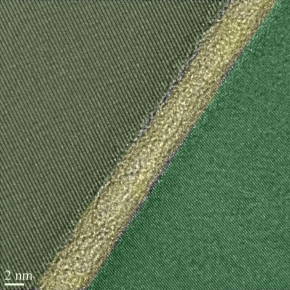
Although olivine is the subject of many studies, the way in which this mineral can be deformed in nature is still poorly understood. Indeed, the crystallographic structure of olivine does not allow the activation of sufficient intracrystalline deformation mechanisms to allow the deformation of a rock without inducing damage and causing breakage. Recent studies suggest that the deformation may be concentrated at the boundaries between the olivine grains but without clearly establishing the mechanisms involved. In this study published in Nature, scientists conducted extensive transmission electron microscopy investigations of deformed samples under high stress. They observed that under these conditions of high pressure and temperature, the walls between the grains present a thin vitrified layer resulting from the mechanical collapse of the crystalline structure of olivine.
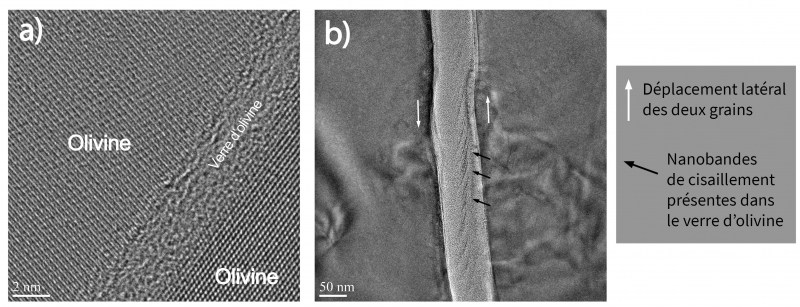
This observation sheds new light on the mechanical properties of rock, because glass has very specific mechanical properties, in particular a sudden drop in viscosity near a characteristic temperature called the glass transition temperature. The authors therefore propose that the softening of this thin intergranular layer would be the trigger of the mechanical transition between the lithosphere and the asthenosphere.
Further Resources
- Scientific article : Stress-induced amorphization triggers deformation in the lithospheric mantle – Nature 591, pages 82–86 (2021) – Vahid Samae, Patrick Cordier, Sylvie Demouchy, Caroline Bollinger, Julien Gasc, Sanae Koizumi, Alexandre Mussi, Dominique Schryvers & Hosni Idrissi. DOI : https://doi.org/10.1038/s41586-021-03238-3
IRAP Contact
- Caroline Bollinger, caroline.bollinger@irap.omp.eu