
Observation of one of the very first galaxies in the Universe
By combining data from two major European observatories located in Chile, and those from the Hubble Space Telescope, a team of scientists composed of an associate researcher and an astronomer of the Institut de recherche en astrophysique et planétologie (IRAP/OMP – CNRS/CNES/UT3 Paul Sabatier) discovered the farthest galaxy known to date. By studying the history of star formation in this galaxy, they were able to demonstrate that this galaxy already existed 250 million years after the Big Bang, thus bringing very strong constraints on the formation patterns of the first galaxies. The results of this study are published in the journal Nature on May 17, 2018.
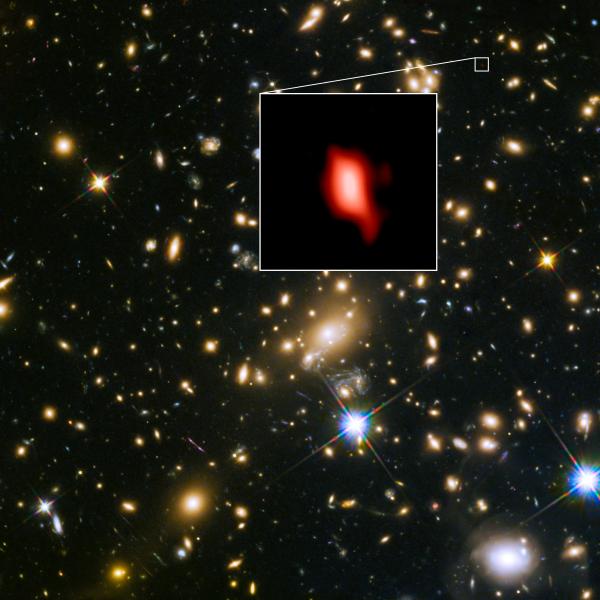
Understanding the formation and evolution of the first galaxies in the Universe is one of the great questions of modern astronomy. In particular, determining the time at which they began to form their first stars, and thus illuminate the Universe, is the cornerstone of models of the formation and evolution of the first galaxies. But locating these astronomical objects at the frontiers of the observable Universe is not easy, because these galaxies are much smaller than the Milky Way, and therefore much less luminous and most of them too faint to be detected by today’s telescopes.
However, the presence of a very massive cluster of galaxies on the line of sight, located between these first objects in the Universe and the telescopes, acts as a magnifying glass, amplifying the light emitted by the galaxies and making them detectable on Earth: this is the method known as gravitational telescopes.
Using this method, a team co-led by Takuya Hashimoto1 and Nicolas Laporte2 was able to locate the most distant galaxy known to date, by combining ultra-deep data from the Hubble Space Telescope and the ALMA and VLT observatories (in Chile). They were able to observe the galaxy MACJ1149-JD1 as it was 542 million years after the Big Bang. Thanks to their observations, they were able to determine the age of the stars in this galaxy and to show that they formed 300 million years earlier, when the Universe was 250 million years old! If MACSJ1149-JD1 is representative of this first generation of galaxies, it may well be that the galaxies formed at that time were much brighter than previously thought.
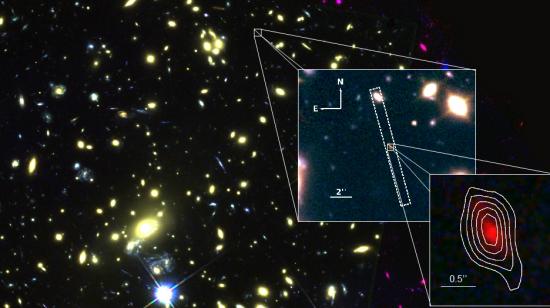
Future studies to be conducted with the new JWST and ELT telescopes will confirm this hypothesis, not only by re-studying this galaxy with greater sensitivity, but also by increasing the samples of objects for which both the time of formation and the physical properties are known.
Notes
1Osaka Sangyo University / National Astronomical Observatory of Japan
2IRAP / University College London
Further Resources
- Publication : Takuya Hashimoto, Nicolas Laporte, Ken Mawatari, Richard S. Ellis, Akio. K. Inoue, Erik Zackrisson, Guido Roberts-Borsani, Wei Zheng, Yoichi Tamura, Franz E. Bauer, Thomas Fletcher, Yuichi Harikane, Bunyo Hatsukade, Natsuki H. Hayatsu, Yuichi Matsuda, Hiroshi Matsuo, Takashi Okamoto, Masami Ouchi, Roser Pell´o, Claes-Erik Rydberg, Ikkoh Shimizu, Yoshiaki Taniguchi, Hideki Umehata, Naoki Yoshida.The onset of star formation 250 million years after the Big Bang,Nature
- ESO Press Release : ALMA and VLT Find Evidence for Stars Forming Just 250 Million Years After Big Bang
IRAP Contacts
- Roser Pello, astronome à l’Université Toulouse III – Paul Sabatier, Institut de Recherche en Astrophysique et Planétologie, Tél : 05 61 33 28 12, rpello@irap.omp.eu
- Nicolas Laporte, chercheur associé à l’Institut de Recherche en Astrophysique et Planétologie, University College London, n.laporte@ucl.ac.uk