
AROMA Setup First Results
The new analytical experimental setup called AROMA (Astrochemistry Research of Organics with Molecular Analyzer) is now in operation at IRAP/LCAR. The main purpose of this setup is to study and identify, with micro-scale resolution, the molecular content of cosmic dust analogues, including the stardust analogues that will be produced in the Nanocosmos Stardust machine in Madrid.
AROMA combines laser desorption/ionization (LDI) techniques with a linear ion trap coupled to an orthogonal time of flight mass spectrometer (LQIT-oTOF). A first paper “Identification of PAH Isomeric Structure in Cosmic Dust Analogues: the AROMA setup” has just been published in The Astrophysical Journal. It presents the performances of AROMA with its ability to detect with very high sensitivity aromatic species in complex materials of astrophysical interest and characterize their structures. A two-step LDI technique was used, in which desorption and ionization are achieved using two different lasers which are separated in time and space.
The tests performed with pure polycyclic aromatic hydrocarbon (PAH) samples have shown a limit of detection of 100 femto-grams, which corresponds to 2×10⁸ molecules in the case of coronene (C24H12). We detected a mixture of PAH small and medium-sized PAHs in the Murchison meteorite that contains a complex mixture of extraterrestrial organic compounds. In addition, collision induced dissociation experiments were performed on selected species detected in Murchison, which led to the first firm identification of pyrene (C16H10) and its methylated derivatives in this sample.
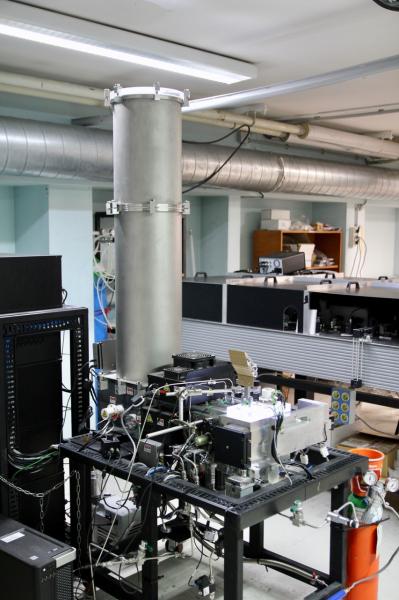
The AROMA setup is one of the new laboratory setups of the Nanocosmos ERC Synergy project. It is installed at the LCAR/IRSAMC laboratory following a collaborative agreement between IRAP and LCAR. Current developments focus on the imaging source that will allow us to characterize samples using LDI techniques with micrometer spatial resolution on the sample surface.
Further Resources
- Article : Identification of PAH Isomeric Structure in Cosmic Dust Analogs: The AROMA Setup, H. Sabbah, A. Bonnamy, D. Papanastasiou, J. Cernicharo, J.-A. Martín-Gago, and C. Joblin, The Astrophysical Journal, 843:34 (8pp), 2017. https://doi.org/10.3847/1538-4357/aa73dd, https://arxiv.org/abs/1705.09974
- Press Release on the Website dedicated to the NanoCosmos project : AROMA Setup First Results
IRAP Contact
- Hassan Sabbah, hassan.sabbah@irap.omp.eu
- Anthony Bonnamy, anthony.bonnamy@irap.omp.eu
- Christine Joblin, christine.joblin@irap.omp.eu