
Back to the Future: viewing Uranus through an ENA camera
The Voyager 2 flyby of Uranus in 1986 portrayed a magnetospheric system now viewed as the reference for an extreme, asymmetric magnetosphere in our solar system. Flying a typical ENA imager onboard a future Uranus orbiter will provide global imaging of this asymmetric magnetosphere that will greatly and uniquely help decipher its structure and dynamics as demonstrated in our simulation runs for Voyager 2 conditions.

The interaction between charged and neutral particles is a common phenomenon in space plasmas. Whenever a singly charged ion undergoes a charge‐exchange process in a collision with a background neutral, an energetic neutral atom (ENA) is born. ENAs are ubiquitous in space environments, and studying them has provided the means to qualitatively improve our understanding of global magnetospheric and heliospheric processes. Cassini was the first interplanetary spacecraft equipped with an ENA imager, the Imaging Neutral Camera (INCA) instrument, to explore Saturn’s magnetosphere. More recently, IRAP contributed to the ENA imager onboard Juice, the Jupiter Energetic Neutral and Ion (JENI) instrument, to explore both Ganymede’s and Jupiter’s magnetospheres.
ENA imaging—the remote‐ sensing technique used to create global images of hot plasma populations in space from ENA measurements—is considered for future exploration of our outer solar system. Regarding a future mission at Uranus, the highest-priority new flagship mission recommended by the 2023–2032 Planetary Science and Astrobiology Decadal Survey, advanced prediction tools are needed to determine the feasibility of exploring its magnetosphere from remote‐sensing imagery.
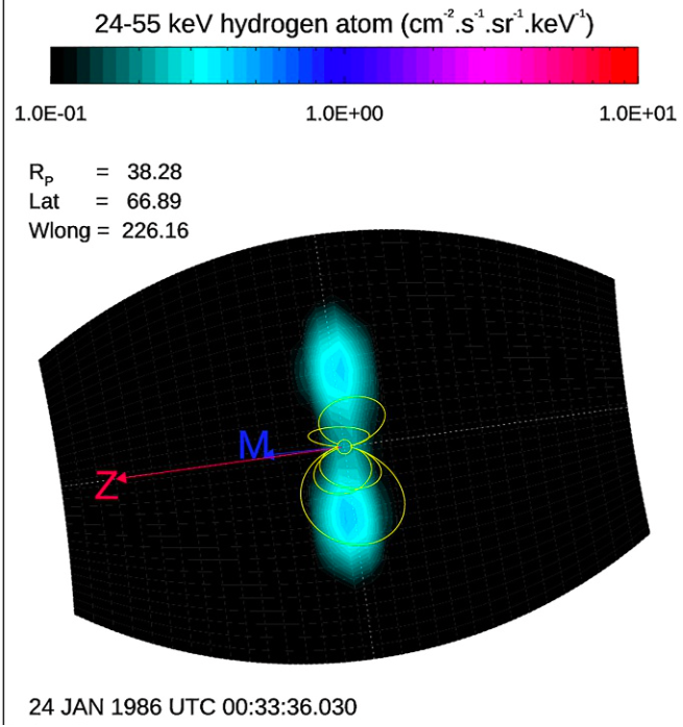
Contribution of Uranus’s hydrogen exosphere and/or moon‐sourced neutral tori to the energetic neutral atom flux map for a given time along the Voyager 2 trajectory, in the energy range of 24–55 keV.
In a recent study published in Journal of Geophysical Research – Space Physics, we present the first‐of‐its‐kind simulator of ENA emissions at Uranus to assist in this endeavor. The production of ENAs from Uranus’s extended exosphere and moon‐induced neutral environment is evaluated. By assuming a virtual detector onboard the Voyager 2 during the Uranus flyby in 1986, the output of our simulator shows that the production of ENAs from the neutralization of the proton belt is sufficient to turn Uranus’s magnetosphere into a detectable ENA‐emitting system. The detection of Uranus’s ENA emissions is found to be doable with a detector similar to the one that was onboard Cassini. Our results provide a compelling case for exploring Uranus’s magnetospheric system through ENA imaging.
Further resource
- Scientific article: What observations would an energetic neutral atom imager have made during the Voyager 2 flyby of Uranus? Daniel Santos-Costa and Nicolas André, Journal of Geophysical Research – Space Physics, 2026. https://doi.org/10.1029/2026JA035080
IRAP Contact
- Nicolas ANDRE (IRAP and ISAE-SUPAERO), nicolas.andre@irap.omp.eu and nicolas.andre@isae-supaero.fr