
SVOM — More than 100 Gamma-ray bursts detected by ECLAIRs!
The SVOM (Space-based multi-band Variable Object Monitor) mission officially began its operational phase on April 23, 2025. The review panel for our first operational review (REVEX), held at the IAP from April 13 to 15, 2026, highlighted the excellent work carried out by the French-Chinese teams in both operational and scientific areas.
The satellite and the space-/ground-based instruments are still operating nominally. ECLAIRs has now detected over 100 bursts with a wide variety of characteristics (i.e., GRB 250314A, a very high-redshift burst at z = 7.3 associated with the explosion of a massive star, ultra-long bursts observed at high energy for several minutes, including one that lasted nearly 1 hour!, 4 short bursts with durations of less than 2 seconds associated with the binary neutron star mergers, and several bursts whose prompt emission is dominated by X-rays rather than gamma rays). Multi-wavelength monitoring of these sources has made it possible to measure the distance to some of these bursts (~40%) between z = 0.238 (~10.9 billion years after the Big Bang) and 7.3 (~729 million years after the Big Bang). As a reminder, a gamma-ray burst signals the violent formation of a stellar-mass black hole or a neutron star and the launch of powerful relativistic jets directed toward Earth.
In addition to gamma-ray bursts, ECLAIRs has detected more than 150 bursts from galactic sources: X-ray binaries, soft gamma repeaters (eruptions on the surface of magnetized neutron stars), magnetars (i.e., highly magnetized neutron stars with magnetic fields reaching 10¹⁴–10¹⁵ G) as well as a few stellar flares from M- and K-type stars, terrestrial gamma-ray flashes (i.e., high-energy bursts associated with large storm cells), auroras observed in X-rays, and solar flares reflected off the Moon!
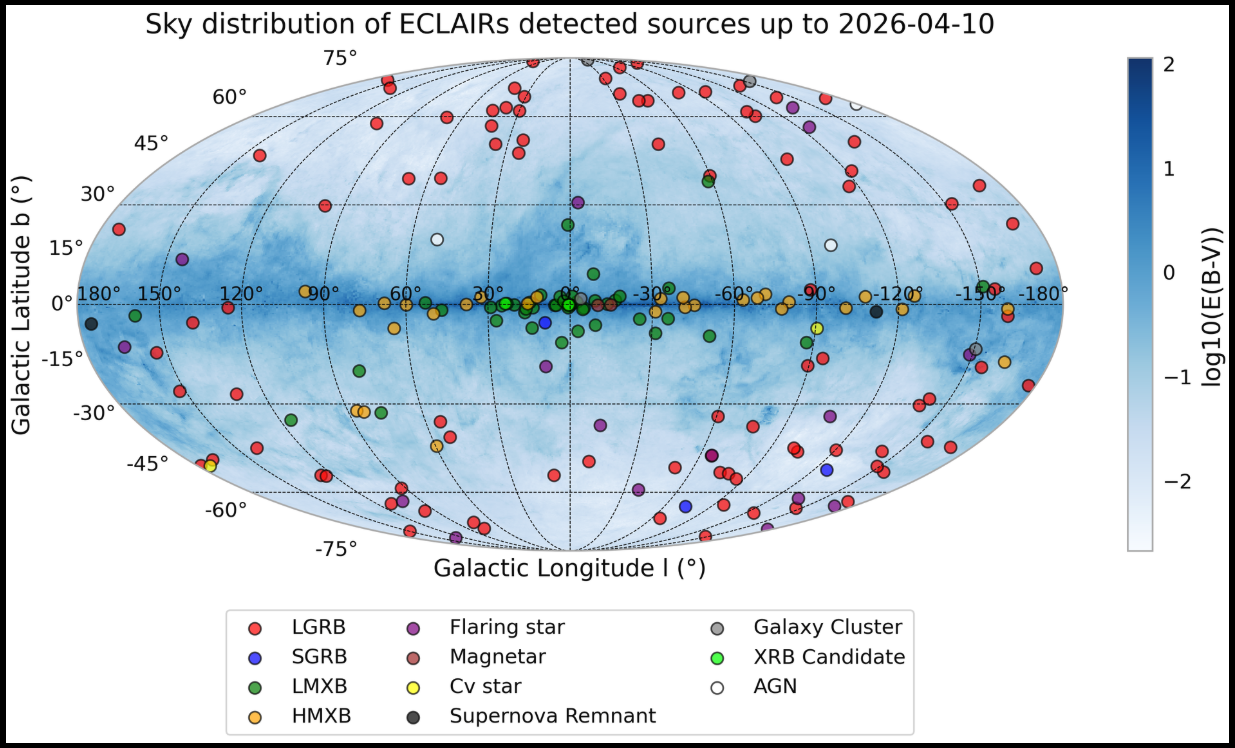
All detections by the ECLAIRs instrument up to April 10, 2026, including long and short gamma-ray bursts and other astrophysical sources.
Further Resources
If you would like to learn more about the instruments and the complex system of the SVOM mission, their performance, and get some highlights on the mission’s first results, we have prepared a series of articles in 2025 that will soon be published in the journal Research in Astronomy and Astrophysics as an SVOM Special Issue volume. The SVOM team at IRAP authored several of these articles and contributed significantly to several others. You can view them on arXiv, along with other published or submitted SVOM articles, at arxiv.org.
IRAP Contact
- Olivier Godet (olivier.godet@utoulouse.fr) on behalf of the SVOM/ECLAIRs, EIC, and CAGIRE teams