A blue aurora observed in our part of the world: a rare and revealing phenomenon
An international team comprising scientists from CNRS Terre & Univers and CNRS Physique observed an exceptional blue aurora at mid-latitudes, revealing unprecedented conditions of interaction between solar particles and the Earth’s atmosphere.
The polar auroras captivate observers with their colors, which are usually green or red. But an international team including scientists from CNRS Terre & Univers and CNRS Physique has observed an exceptional phenomenon: a blue aurora visible at mid-latitudes, well south of the regions where they usually appear.
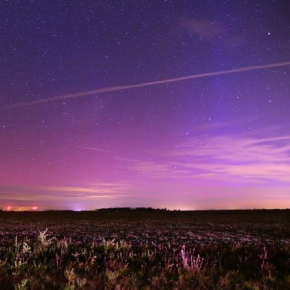
This rare observation is evidence of an intense episode of space weather, capable of extending auroral activity to unusual latitudes. But what makes this event particularly remarkable is its color: blue, which is very rarely seen in auroras.
Unlike green and red emissions, which are linked to atmospheric oxygen, blue emissions result primarily from the excitation of nitrogen molecules by energetic particles. These emissions are generally weak and masked, making their detection exceptional.
Through a detailed analysis, scientists have shown that this optical signature results from specific conditions in the atmosphere and in the incoming particle flux. These findings provide a better understanding of the physical mechanisms underlying auroras, particularly under extreme conditions.
Beyond its spectacular nature, this observation enhances our understanding of the interactions between the solar wind, Earth’s magnetic field, and the atmosphere. It thus helps refine space weather models, which are essential for predicting the effects on satellites, communications, and electrical infrastructure.
CNRS Laboratories involved
- CNRS Terre & Univers :
- Institut de Recherche en Astrophysique et planétologie (IRAP – OMP), Tutelles : CNRS / CNES / Univiversité de Toulouse
- Institut de planétologie et d’astrophysique de Grenoble (IPAG – OSUG), Tutelles : CNRS / UGA
- CNRS Physique :
- Laboratoire dee physique des solides (LPS), Tutelles : CNRS / Université Paris Saclay
Further Resource
- Scientific paper : Emmanuel Beaudoin, Jean Lilensten, Guillaume Gronoff, Gaël Cessateur, Léo Bosse, Mathieu Barthélemy, Frédéric Pitout, Cyril Simon Wedlund and Hervé Lamy, J. Space Weather Space Clim. Volume 15, 2025
IRAP Contact
- Frédéric Pitout, frederic.pitout@irap.omp.eu