
Magnetic reconnection models validated by analysis of twenty years of measurements
By allowing plasmas to exchange their magnetic connection, the magnetic reconnection process enables the sudden release of magnetic energy in the form of accelerated particles and rapid, heated flows. For more than half a century, reconnection has been suspected of playing a key role in scenarios explaining intense energetic events in the Universe, from the solar corona to that of stars or accretion disks, from planetary magnetospheres to those of black holes and neutron stars.
Due to its relative proximity, the Earth’s space environment is a formidable laboratory where plasma processes can be studied by measuring the properties of plasma and the magnetic field in situ using satellites. Magnetic reconnection plays an important role here: it connects the interplanetary and terrestrial magnetic fields, allowing solar wind plasma to penetrate the otherwise confined magnetosphere.
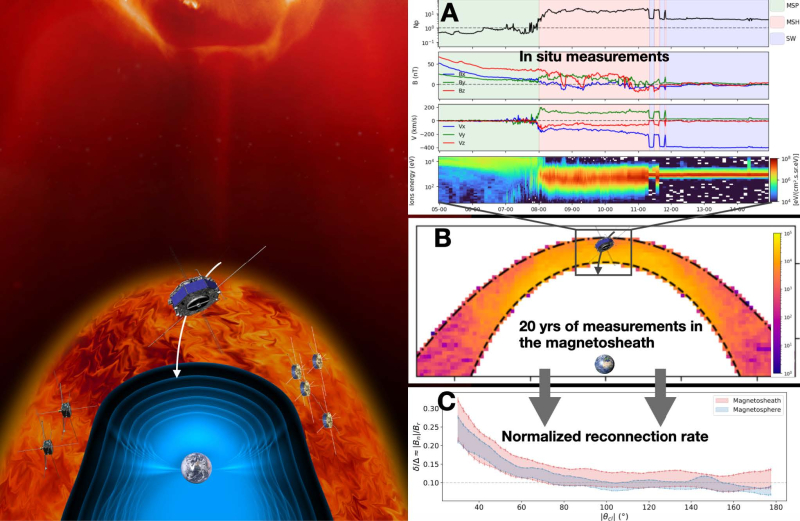
To explain these often explosive events, however, reconnection must be fairly rapid—a speed that numerical models have been predicting for 30 years, but which observational measurements have struggled to confirm. This has now been achieved thanks to a team of researchers from the CNRS, ONERA, the University of Toulouse, including the Institute for Research in Astrophysics and Planetology (IRAP/OMP), and NASA. Using machine learning algorithms, NASA conducted a statistical analysis of the magnetic field at the magnetopause (1), based on 20 years of data measured in situ by four different space missions in the Earth’s magnetosphere.
These observational results demonstrate the importance of exploring our space environment in order to understand fundamental processes. They also illustrate the growing role of machine learning algorithms in the future exploitation of the treasure trove of data measured over the past decades and by future missions planned by the community.
Note
1 Interface entre le vent solaire et la magnétosphère
CNRS Laboratories involved
- Institut de recherche en astrophysique et planétologie (IRAP/OMP) – Tutelles : CNRS / CNES / Université de Toulouse
- Laboratoire de Physique des Plasmas (LPP) – Tutelles : CNRS / Ecole polytechnique / Sorbonne université
Further Resource
- Scientific article : Statistical Estimate of the Magnetopause Reconnection Rate as a Function of the Interplanetary Magnetic Field Clock Angle, B. Michotte de Welle, N. Aunai, B. Lavraud, V. Génot, G. Nguyen, A. Ghisalberti, A. Jeandet, D. Sibeck, H. Connor, Geophysical Research Letters , 2025. DOI: 10.1029/2025GL119118
IRAP Contact
- Vincent Genot, vincent.genot@irap.omp.eu