
All about the solar flare of January 18, 2026
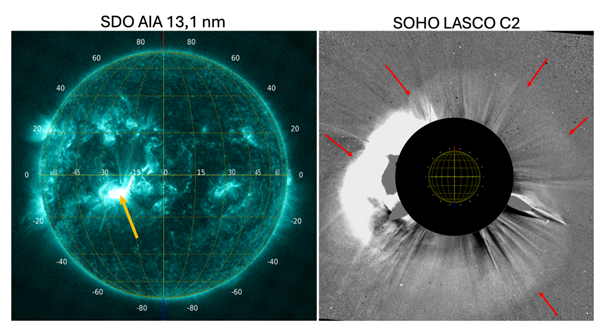
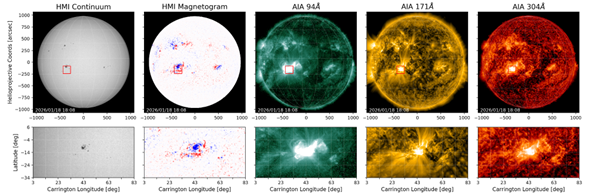
An X1.9-class solar flare that occurred on January 18 at 18:09 UT (Figure 1) generated a very fast solar storm directed towards Earth, causing a geomagnetic storm that began on Monday night and continued into Tuesday. This storm produced beautiful auroras that were observed in France. The INSU National Observation Services (including our solar instruments – BCMT – and space instruments and our MEDOC, CDPP, STORMS, and ISGI data services), in close collaboration with the French Organization for Applied Research in Space Meteorology (OFRAME), continuously monitor these phenomena.

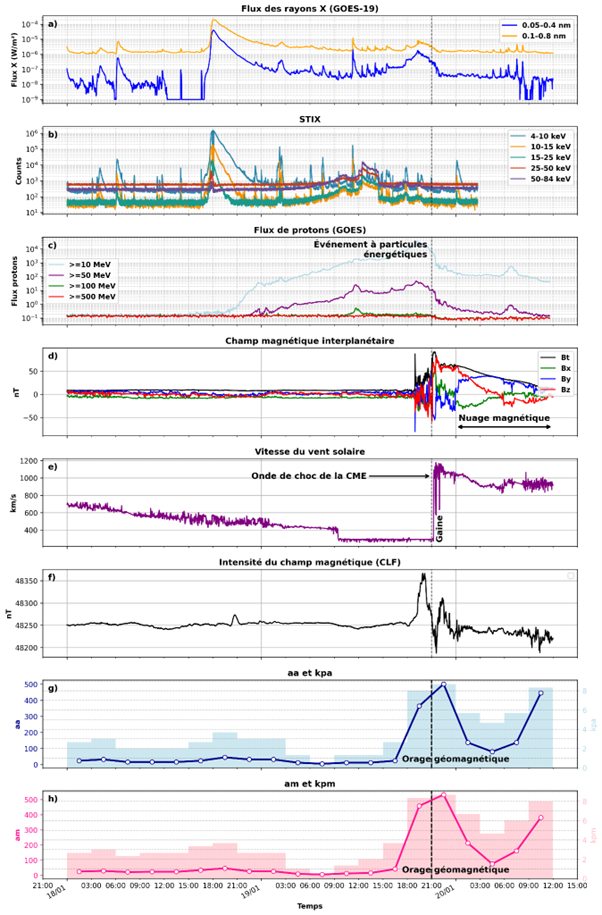
The X1.9 solar flare was followed by a coronal mass ejection (CME) detected by the French coronagraph LASCO C2 on the SoHO probe (Figure 2). This CME had a “halo” morphology, indicating that it was propagating toward Earth; the initial speed of the CME was estimated to be greater than 2000 km/s. The shock wave ahead of the CME accelerated a large flow of solar particles, causing a sustained increase in particle fluxes before the arrival of the wave front. As it propagated towards Earth, the flow of high-energy particles intensified. The proton flux has been unprecedented since 2003, with energies greater than 10 MeV but less than 100 MeV (Figure 2). The neutron monitors operated by France in Kerguelen and Adélie Land (as well as the global network of monitors) did not detect any sudden bursts of particles on the ground, confirming that the energy of the accelerated particles was less than 500 MeV. The impact of the CME on Earth was measured by neutron monitors through a Forbush decrease corresponding to a drop in the intensity of galactic cosmic radiation during the passage of the CME.
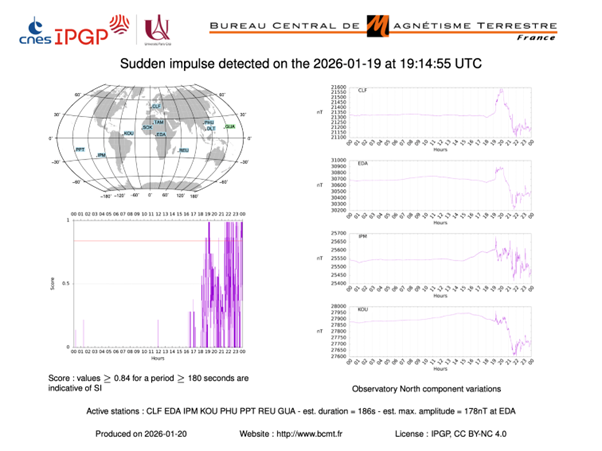
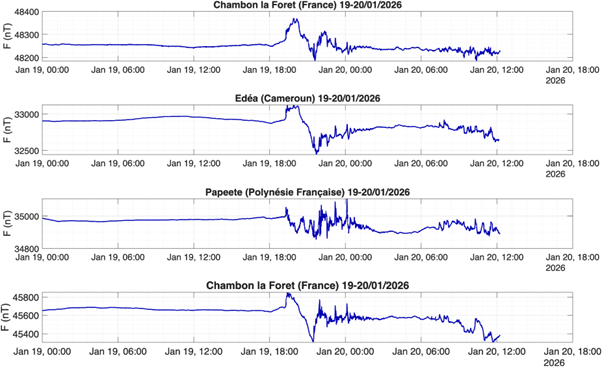
The shock wave reached the vicinity of Earth at around 21:20 UT yesterday evening, with a measured arrival speed of approximately 1000 km/s and a magnetic field intensity greater than 50 nT (Figure 2). A sudden magnetic pulse was observed at all ground-based magnetic observatories starting at 19:14 UT, coinciding with strong variations in the direction of the interplanetary magnetic field upstream of the shock wave (Figure 2). This pulse was strongest over Africa, with a variation of 178 nT in about ten minutes, which is quite exceptional for this type of phenomenon. The magnetic variations measured on the ground in the following hours (Figure 2) resulted in high magnetic activity indices (aa: 502 nT; am: 533 nT; Kp = 9-; Ds: -158 nT).
The evolution of this solar storm shows the classic signs of a CME: after the initial impact of the shock wave, which marked the beginning of the geomagnetic storm, we are currently (14:00 UT) passing through the magnetic cloud of the CME (Figure 2), whose speed and complex magnetic field are contributing to maintaining a high level of geomagnetic activity. Despite the interplanetary magnetic field remaining generally northward during the main phase of the storm, the coupling with the geomagnetic field was very strong. The geomagnetic storm could have been even more significant if it had been southward.
Intense auroras were observed at mid-latitudes, particularly in France. This storm is a textbook case, with a very fast CME that was directed towards Earth. Unlike the events that also produced beautiful auroras in May 2024, this event involved a single CME and is therefore unlikely to continue. However, the Sun remains very active and the sunspot that generated this storm is still close to the central meridian and could produce other solar storms directed towards Earth.
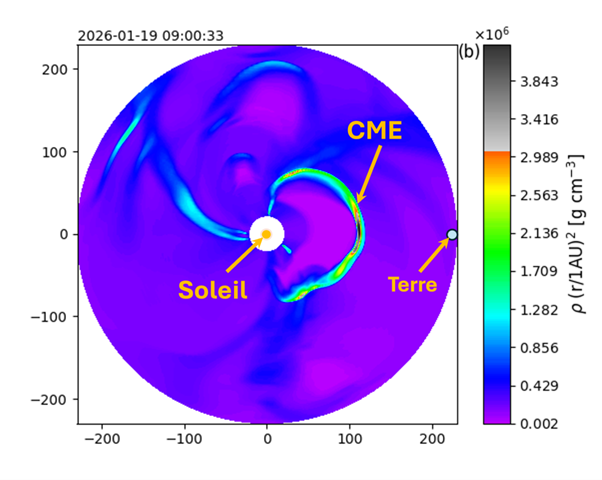
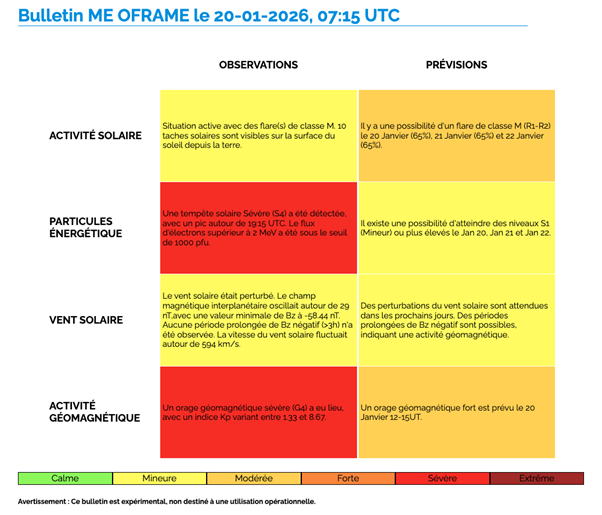
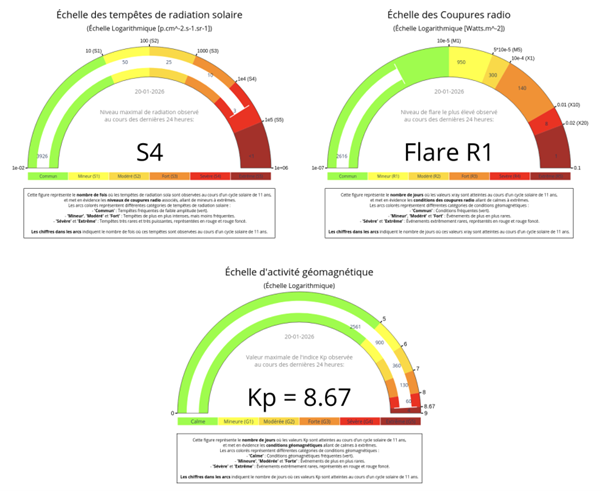
The automated bulletin set up by OFRAME enabled continuous monitoring of the situation, highlighting when alert thresholds were exceeded for solar radiation storms, radio blackouts, and geomagnetic storms (Figure 4 and Figure 5).
Abbreviations
- OFRAME: French Organization for Applied Research in Space Meteorology.
- NOAA: National Oceanic and Atmospheric Administration.
- CME: Coronal Mass Ejection.
- UT: Universal Time.
Laboratories involved
- Institut de Recherche en Astrophysique et planétologie (IRAP – OMP)Tutelles : CNRS / CNES / Univiversité de Toulouse
- Institut d’astrophysique spatiale (IAS – OSUPS)Tutelles : CNRS / Univ. Paris Saclay
- Institut de planétologie et d’astrophysique de Grenoble (IPAG – OSUG)Tutelles : CNRS / UGA
- Laboratoire d’Instrumentation et de Recherche en Astrophysique (LIRA -Observatoire de Paris – PSL)Tutelles : CNRS / Obersvatoire de Paris – PSL / Sorbonne Univ / Univ Paris Cité
- Institut de physique du globe de Paris (IPGP)Tutelles : CNRS / IPG / UNIV PARIS CITE
- Laboratoire de physique et chimie de l’environnement et de l’Espace (LPC2E – OSUC)Tutelles : CNRS / CNES / Univ. Orléans
- Laboratoire de physique des plasmas (LPP)Tutelles : CNRS / Ecole Polytechnique / Sorbonne Univ
- Laboratoire Astrophysique, Instrumentation, Modélisation (AIM – OSUPS)Tutelles : CEA / CNRS / Univ Paris Cité
- ONERA
- Univ. de Strasbourg
Further Resources
- Learn more about the implications with the list of all laboratories involved in the scientific coordination of OFRAME. : https://meteo-espace.irap.omp.eu