
A comprehensive and modern description of magnetodisk physics at Jupiter !
The Jovian magnetodisk refers to a thin disc of plasma and electric currents in the magnetosphere of Jupiter located near the equatorial plane beyond the orbit of the moon Io, the dominant plasma source of the system. The Jovian magnetodisk exchanges mass, energy, and momentum with the Io plasma torus via radial transport likely driven by the interchange instability and larger scale transport processes. At the other end of the flow of cold plasma, it is coupled with the outer magnetosphere and magnetic tail, where the plasma is mainly lost from the system. The Jovian magnetodisk is also coupled with the upper atmosphere/ionosphere via field-aligned currents. This current system is partially responsible for (or at least related to) the main aurora emissions and the heating of the upper atmosphere/ionosphere.
In a study recently published in the Journal of Geophysical Research: Space Physics, a team of IRAP scientists in collaboration with researchers from the Southwest Research Institute, the University of Colorado, and the Johns Hopkins University combined in situ observations of plasma and energetic charged particles from the Juno missions and detailed the properties of magnetodisk plasma by generating spatial distributions of the number density, pressure, and velocity of electrons, protons and heavy ions to ultimately provide a comprehensive and modern description of magnetodisk physics, both in term of structure and dynamics.
The Jovian magnetodisk appeas approximately in force balance, with the magnetic stress force being the only force pointing towards the planet, the outward forces being dominated by the anisotropy pressure force (73%), with the pressure gradient force being secondary (19%), and the centrifugal force (7%) and magnetic pressure force (1%) not important in general. The Velocity Distribution Functions for all species are anisotropic with a pressure parallel to the magnetic field larger than the perpendicular pressure. The estimated timescale of radial transport from 20 to 80 Jovian radii is of the order of 7 hr, with a total plasma mass in these regions of 5 10^7 kg, and a thermal energy of 3.8 10^37 eV.
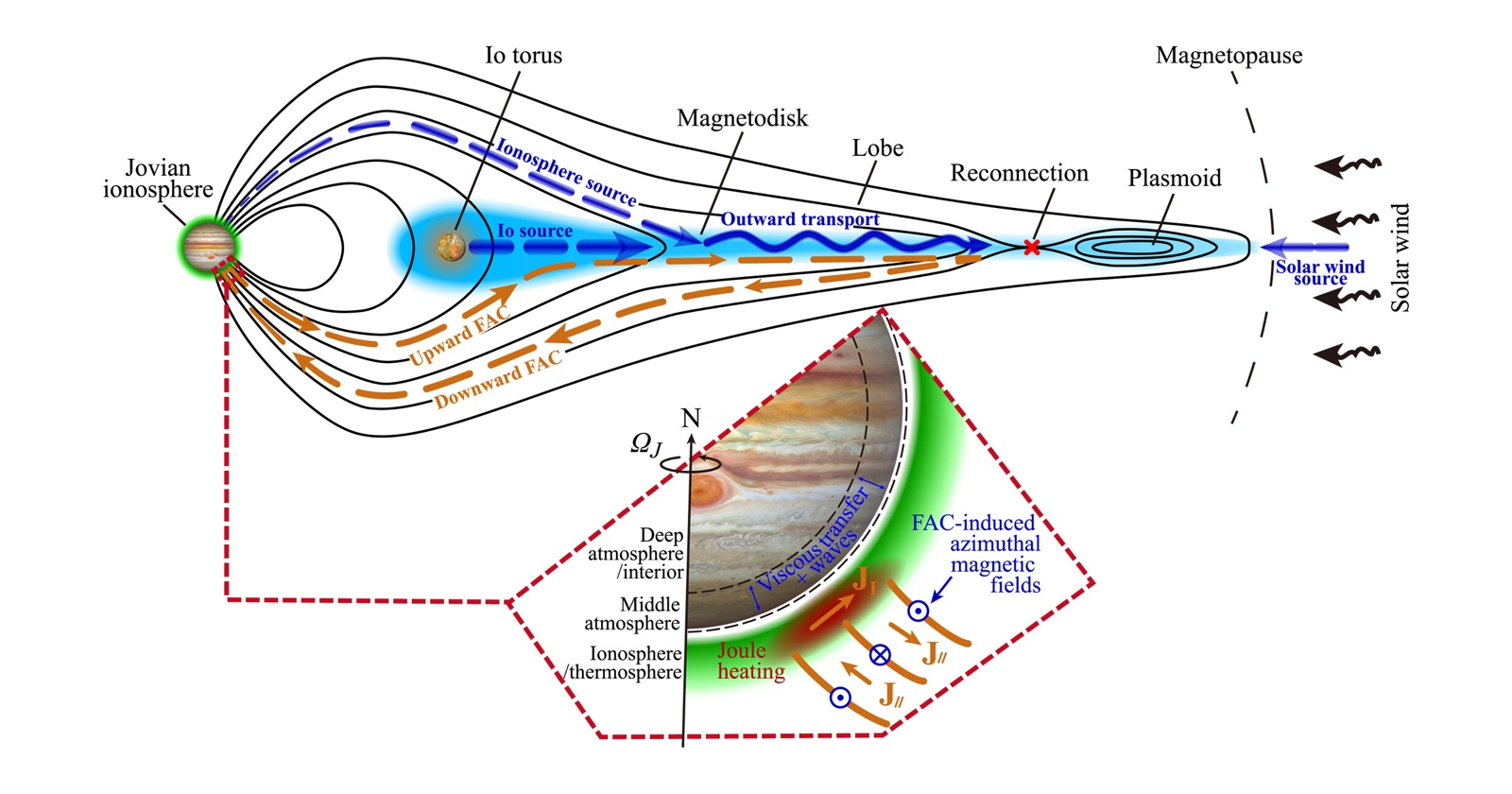
Schematic of the Jovian magnetodisk and its connection to other components of the Jupiter system. The black curves illustrate the magnetic field lines. The blue dashed arrows indicate the three primary mass sources of the magnetodisk: the Io torus (and possibly other moons), Jovian ionosphere, and the solar wind. The blue solid arrow indicates the outward transport of cold plasma (Inward injection of hot plasma is not shown here for figure clarity). The orange dashed curves illustrate the large-scale electric currents connecting the magnetodisk and the ionosphere, as predicted by the corotation enforcement model. The inset illustrates how this current system is coupled and interacts with the atmosphere.
The plasma distributions presented in this paper will serve as reference for future missions like the Juice and Europa Clipper missions, currently en route to Jupiter.
Further Resources
- Publication scientifique : Liu, Z.-Y., Blanc, M., André, N., Bagenal, F., Wilson, R.J., Allegrini, F., Devinat, M., Mauk, B.H., Conerney, J.E.P., Bolton, S.J. (2024). Juno Observations of Jupiter’s Magnetodisk Plasma: Implications for Equilibrium and Dynamics. Journal of Geophysical Research: Space Physics, 129(1), https://doi.org/10.1029/2024JA032976.
IRAP Contacts
- Zhi-Yang Liu : zhi-yang.liu@irap.omp.eu
- Nicolas ANDRE (IRAP and ISAE-SUPAERO), nicolas.andre@irap.omp.eu et nicolas.andre@isae-supaero.fr
- Michel Blanc : michel.blanc@irap.omp.eu
- Marie Devinat : marie.devinat@irap.omp.eu