
When the stars fade: astronomy and its carbon footprint
The Paris Agreement (1) sets an ambitious target of carbon neutrality (2) by 2050 to tackle global warming. All sectors are concerned, including astronomical research. A research team has just carried out a ground-breaking study into the evolution of the carbon footprint of astronomical observatories and space missions. The results, published in Nature Astronomy, reveal a worrying trend that calls for an in-depth rethink of research practices in this field.
To carry out this study, scientists from CNRS Terre & Univers compiled an exhaustive inventory of 1,211 notable astronomical infrastructures since 1945. They then modeled the annual greenhouse gas emissions profile for each of them, based on criteria such as cost, size or weight, while taking into account changes in the carbon intensity of the economy. This innovative approach has enabled us to build up a comprehensive picture of the evolution of the carbon footprint of astronomical research over several decades.
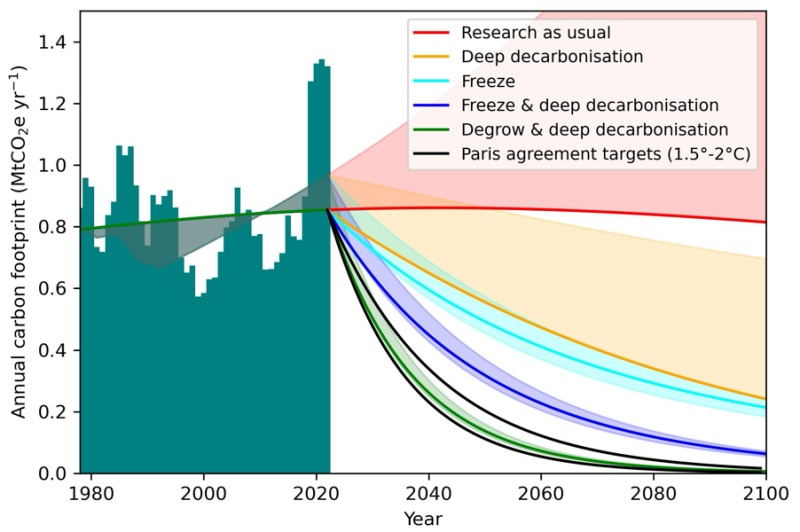
The results are indisputable: emissions are on a rising trend, largely dominated by space missions. Extrapolation of these trends shows a trajectory that is incompatible with the objectives of the Paris Agreement, even in the event of accelerated decarbonization. Only a combination of deep decarbonization and limiting, or even reducing, the number of means of observation would make it possible to achieve the targeted carbon neutrality. This study raises fundamental questions about the future of astronomy and astrophysics research. It calls on the scientific community to think deeply about its practices and to consider major changes to ensure a sustainable trajectory, without compromising crucial scientific advances in this field.
Notes
- Paris Agreement: international treaty on climate change, adopted in 2015, aiming to limit global warming to well below 2°C, preferably 1.5°C, above pre-industrial levels
- Carbon neutrality: a state of equilibrium between greenhouse gas emissions and their absorption by carbon sinks.
CNRS Laboratory involved
- Institut de recherche en astrophysique et planétologie (IRAP – OMP) – Tutelles : CNRS / CNES / Université Toulouse III – Paul Sabatier
Further Resources
- Scientific Publications :
- Knödlseder, J. et al. Scenarios of future annual carbon footprints of astronomical research infrastructures. Nat. Astron. (2024). DOI : 10.1038/s41550-024-02346-0
- Knödlseder, J., The carbon footprint of astronomical observatories, https://arxiv.org/abs/2409.04054
- Press Review :
- Spatial : « L’astronomie doit décroître face à l’urgence climatique » (La Tribune)
- L’astronomie face à une empreinte carbone croissante (France Culture)
IRAP Contacts
- Jürgen Knödlseder, jurgen.knodlseder@irap.omp.eu
- Mickael Coriat, mickael.coriat@irap.omp.eu
- Philippe Garnier, philippe.garnier@irap.omp.eu
- Annie Hugues, annie.hugues@irap.omp.eu