
The influence of Ganymede’s magnetosphere seen right down to its auroral footprint on Jupiter
Jupiter has the brightest aurora in the solar system. A particular feature of this planet, which it shares with Saturn, is also the auroral emissions caused by three of its largest moons: Io, Europa and Ganymede. These distinct emissions, known as “auroral imprints”, are visible locally in several wavelength ranges. They are created by charged particles, mostly electrons, propagating along the magnetic field lines linking the moons to Jupiter. As they precipitate into the atmosphere of the giant planet, these electrons induce characteristic auroras, studied since the 2000s thanks in particular to ultraviolet observations by the Hubble Space Telescope.
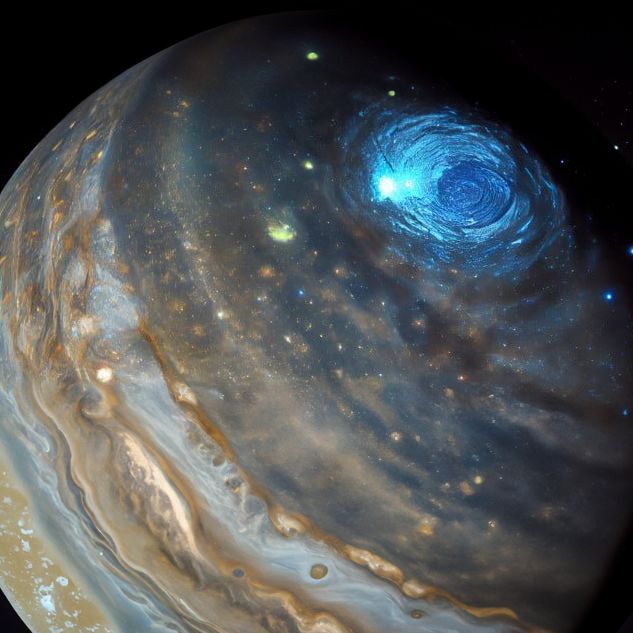
Since July 2016, the Juno probe has been flying over Jupiter’s poles at an altitude of just a few thousand kilometers, enabling fine characterization of the structure of the moons’ auroral footprints. The combined analysis of data obtained on board Juno by the UVS spectrograph and the JADE spectrometer, for which IRAP contributed the electrostatic optical system, enables us to probe both the properties of these emissions and those of the charged particles that induce them.
Focusing their study on the auroral footprint of Ganymede, the largest moon in the Solar System and the only one to generate its own magnetic field, a team including scientists from CNRS Terre & Universe, in close collaboration with teams from the Juno mission (SwRI, Princeton University), have, among other things, highlighted the influence of Ganymede’s mini-magnetosphere on its auroral footprint. They confirmed that the size of the flux tubes – tubular magnetic field lines linking the moons to Jupiter’s atmosphere, through which electromagnetic waves and charged particles propagate – is significantly larger than those reported for Io and Europa in previous studies. Juno’s observations of the auroral footprint thus provide a new method for studying Ganymede’s mini-magnetosphere, which will be explored in-situ in an unprecedented way by ESA’s JUICE mission currently en route to Jupiter.
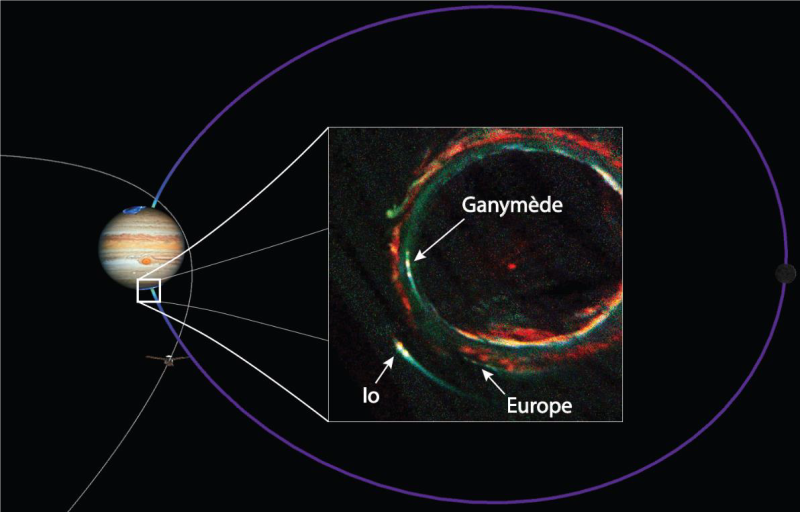
Laboratories CNRS Terre & Univers involved
- Institut de recherche en astrophysique et planétologie (IRAP – OMP) – Tutelles : CNRS / Université Toulouse 3 Paul Sabatier / CNES
- Laboratoire d’astrophysique de Marseille (LAM – PYTHEAS) – Tutelles : CNRS / Aix-Marseille Université / CNES
Further Resource
- Scientific article : Rabia, J., Hue, V., André, N., Nénon, Q., Szalay, J. R., Allegrini, F., et al. (2024). Properties of electrons accelerated by the Ganymede-magnetosphere interaction: Survey of Juno high-latitude observations. Journal of Geophysical Research: Space Physics, 129, e2024JA032604. https://doi.org/10.1029/2024JA032604
IRAP Contacts
- Jonas Rabia, jonas.rabia@irap.omp.eu
- Nicolas André, nicolas.andre@irap.omp.eu
- Quentin Nénon, quentin.nenon@irap.omp.eu