
The icy moon Ganymede has its own radiation belts!
The magnetic field of a planet can trap energetic charged particles in donut-shaped « radiation belts ». In order to better understand the formation of planetary radiation belts, a team of researchers from U.C. Berkeley (Space Sciences Lab) and from France (IRAP-CNRS-INSU) has recently focused on Ganymede, the largest moon of Jupiter. Ganymede has the particularity to possess its own magnetic field, which is strong enough to create a mini-magnetosphere inside that of Jupiter. However, is the magnetic field of Ganymede also able to efficiently trap radiation belts? The collaboration between U.C. Berkeley and France on this topic has received the support of the France – Berkeley fund (https://fbf.berkeley.edu/).
The researchers have focused on the measurements gathered by NASA’s Galileo spacecraft when it flew by Ganymede in May 20, 2000. The Galileo observations of energetic electrons have been reanalyzed by the French colleagues and show that the flux of particles is maximum in the direction perpendicular to the local magnetic field. This kind of distribution is known as « pancake ». Galileo data has then been confronted with numerical simulations run by the Berkeley scientists.
The data – simulation comparison reveals that the electron pancakes observed by Galileo come from electrons trapped around the icy moon! This finding is strong evidence that Ganymede has its own radiation belts.
The simulations then inform on the origin and stability of the Ganymede radiation belts. The particles are first injected from the Jovian magnetosphere to the mini-magnetosphere of the moon. They then orbit around Ganymede a few times before impacting the icy surface or escaping back to the Jovian magnetosphere. The velocity of the particles trapped near Ganymede is driven by two main physical mechanisms: the conservation of adiabatic invariants – a classic of planetary radiation belts, and the effect of electric fields found inside the mini-magnetosphere.
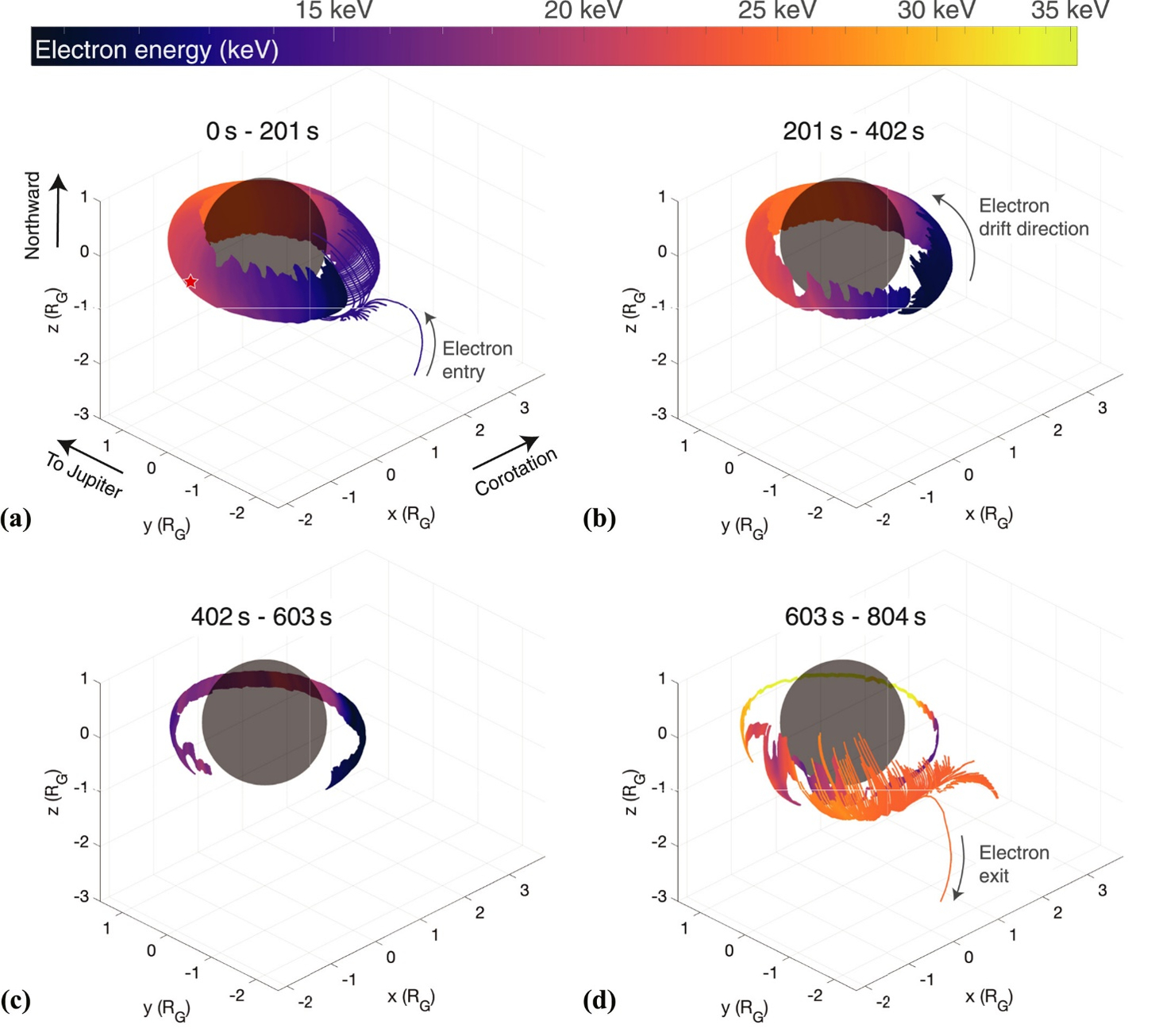
Simulated trajectory of an electron observed by the Galileo spacecraft at the position marked with the red star. The four panels show the four orbits completed by the particle around Ganymede before returning to the Jovian magnetosphere. Credit : Liuzzo et al. (2024), https://agupubs.onlinelibrary.wiley.com/doi/full/10.1029/2024GL109058
This reanalysis of 24-year-old Galileo data paves the way for ESA’s JUICE mission on its way to the Jovian system. JUICE will enter a low-altitude polar orbit around Ganymede in 2033. The mission will then be able to fully characterize the three-dimensional distribution of Ganymede’s radiation belts and will use its advanced instrument suite to study the physical mechanisms at work. JUICE will for sure push forward our understanding of the Ganymede radiation belts, discovered by Galileo in 2000.
Further Resource
- Scientific article : « On the Formation of Trapped Electron Radiation Belts at Ganymede » by Lucas Liuzzo, Quentin Nénon, Andrew R. Poppe, Aaron Stahl, Sven Simon, Shahab Fatemi, Geophysical Research Letters, 10 May 2024, https://doi.org/10.1029/2024GL109058
IRAP Contact
- Quentin Nénon, quentin.nenon@irap.omp.eu