
At Lacq, injection of industrial wastewater identified as the main cause of earthquakes
Each year, numerous earthquakes are detected in the Lacq region of Pyrénées-Atlantiques, without the exact cause being clearly identified. An international study led by Jean Letort, a teacher-researcher at Toulouse III – Paul Sabatier University and member of the Institut de recherche en astrophysique et planétologie (IRAP/OMP – CNES/CNRS/UT3), has confirmed a recent hypothesis. Industrial wastewater injections are at the origin of the region’s seismicity. The results were published on May 23 in Geophysical Journal International.
Every year since 1969, hundreds of earthquakes, some of them felt by the general public, have been detected very locally in the Lacq region of south-western France. This seismicity cluster is quite distinct from the natural seismicity of the Pyrenees chain, which extends further south: it has long been considered induced, i.e. generated by the subsoil mining activities carried out in this region.
However, the exact cause of this cluster of earthquakes was still debated. For a long time, it was attributed to past intense gas extraction activities from the deep reservoir, which would have led to its contraction and progressive collapse, bringing the rocks to a state close to rupture. But another hypothesis began to emerge three years ago. This gives a major role to wastewater from industrial activities, injected into the reservoir.
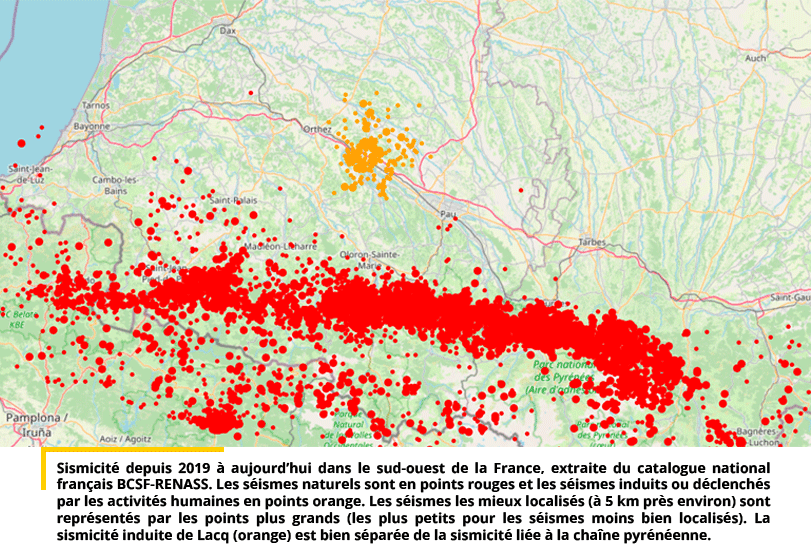
To test this hypothesis, a Franco-German research team (1) set out to better understand the links between human activity and seismicity. “A network of some fifteen seismological sensors was deployed around Lacq to better locate these induced earthquakes. They are triggered in and below the deep reservoir, most of them between four and five kilometers below the surface,” explains Laeticia Jacquemond, principal author and student in the Master 2 program in Earth, Planetary and Environmental Sciences at the university during the preparation of this study. Continuous recording of ground movements over a three-year period detected around a hundred microearthquakes, making it possible for scientists to pinpoint their precise location and analyze them.
The team’s conclusions are unequivocal. By compiling an analysis of recent earthquakes, as well as those that have occurred over the last 50 years, the Franco-German team has highlighted the predominant role of injection in generating seismicity in the Lacq region. The majority of earthquakes are located very close to the reservoir boundaries, and the seismic energy released is directly linked to variations in the volume injected into the reservoir.
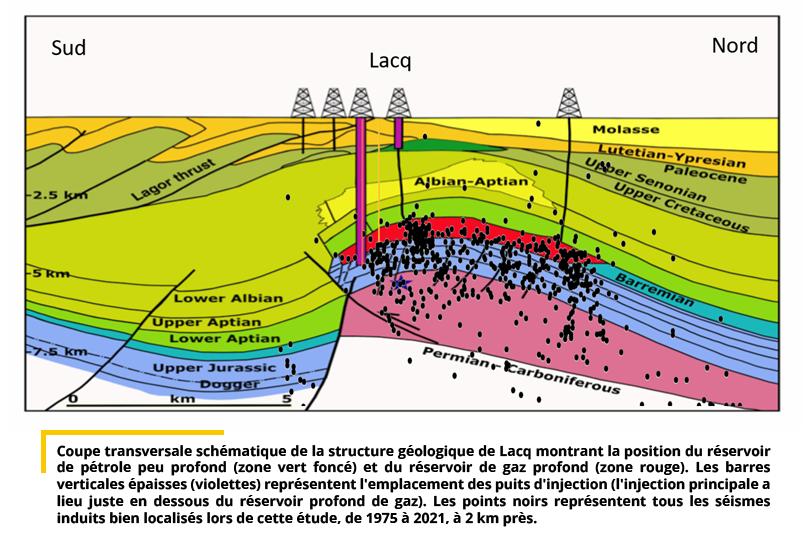
This study sheds crucial light on the interactions between injection activities and seismicity in the Lacq region. Jean Letort, a teacher-researcher at IRAP, stresses the lack of instrumentation since the 2000s, the importance of continuous monitoring and “the need for more in-depth studies on the prediction of seismic hazard and risk. This is particularly true of the development of seismicity prediction models based on injection rates and volumes, which requires access to detailed information on injection operations and reservoir properties”.
The data from this temporary network, deployed at Lacq, and the seismicity catalogs built during the project are being made public to support future studies on seismic processes during reservoir injection operations. This is a crucial issue for the management of wastewater injections, but also for deep geothermal energy and carbon dioxide sequestration projects, in order to best assess the hazard and risk associated with these projects.
Note
(1) The University of Grenoble-Alpes, the University of Pau and Pays de l’Adour and the German research center for geosciences (GFZ) in Potsdam are also involved in this study.
Further Resources
- Scientific publication : « Analysing 50 yr of the Lacq induced seismicity (Southwestern, France) highlights the role of fluid injection » by L Jacquemond, J Letort, F Cotton, M Causse, J R Grasso, G Senechal, J B Ammirati, B Derode, F Grimaud, H Pauchet, S Benhamed, M Sylvander, Geophysical journal international, mai 2024
- Press Release :
- A Lacq, l’injection d’eaux usées industrielles identifiée comme principale responsable des séismes (Université Paul Sabatier de Toulouse)
- A Lacq, l’injection d’eaux usées industrielles identifiée comme principale responsable des séismes (Université Paul Sabatier de Toulouse)
IRAP Contact
- Jean Letort, jean.letort@irap.omp.eu