
Delivery of the PAS French instrument for the Solar Orbiter mission
The PAS (Proton-Alfa Sensor) sensor, designed and developed by the IRAP teams (CNRS / CNES / Paul Sabatier University), will be delivered to ESA on 13 June 2017 to equip its Solar Orbiter probe. PAS is part of the Solar Wind Analyzer (SWA) instrument dedicated to the analysis of the solar wind particles.
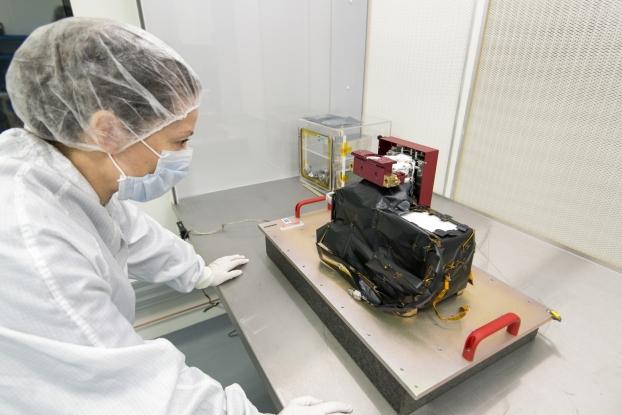
Solar Orbiter will be launched in early 2019 to study the organization and dynamics of the Sun’s atmosphere’s structures, as well as the characteristics of the particle fluxes and waves propagating in interplanetary space. PAS, together with the other ten Solar Orbiter instruments, will establish the connection between the solar surface, its magnetic structures, their dynamics and the characteristics of the solar wind, its magnetic field, its waves and its most energetic particle populations. The challenge is also to understand how the Sun affects the solar wind and the terrestrial space environment.
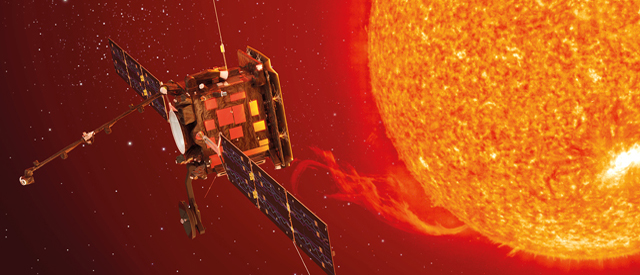
The PAS instrument will contribute to this by measuring the density, the velocity and the temperature of the solar wind and, more specifically, the particle distribution function. At a rate of up to 10 million measurements per second, it will determine the direction of arrival and the energy of each particle passing through its input slot and will perform a first digital processing of these data before retransmission to the Earth. The measurements, one hundred times faster than what has been done so far, will enable us to study the turbulence and the essential wave / particle interactions in the dynamics of the solar wind. During the mission, the temperature of its thermal shield will be able to vary between -120 ° C and 450 ° C.
Together with the other instruments of Solar Orbiter, PAS will irrigate by its measurements a global community of a few hundred researchers, from 2019 and well beyond 2030.
IRAP Contact
- Philippe Louarn, philippe.louarn@irap.omp.eu