
SHOCK REGIME WITH LOW-TEMPERATURE COOKING FOR LEES: SHAKE WELL BEFORE SERVING HOT!
The mechanical and thermal model (STM) of the Low-Energy Electron Spectrometer (LEES) instrument, for which IRAP is responsible, has successfully passed a series of environmental tests (temperature, vibration, and shock) that verified its design against the mechanical and thermal constraints it will encounter during launch and then in space. This validated test campaign thus allows the start of production of the instrument’s flight model, which will be delivered in early 2026 to CBK in Poland.
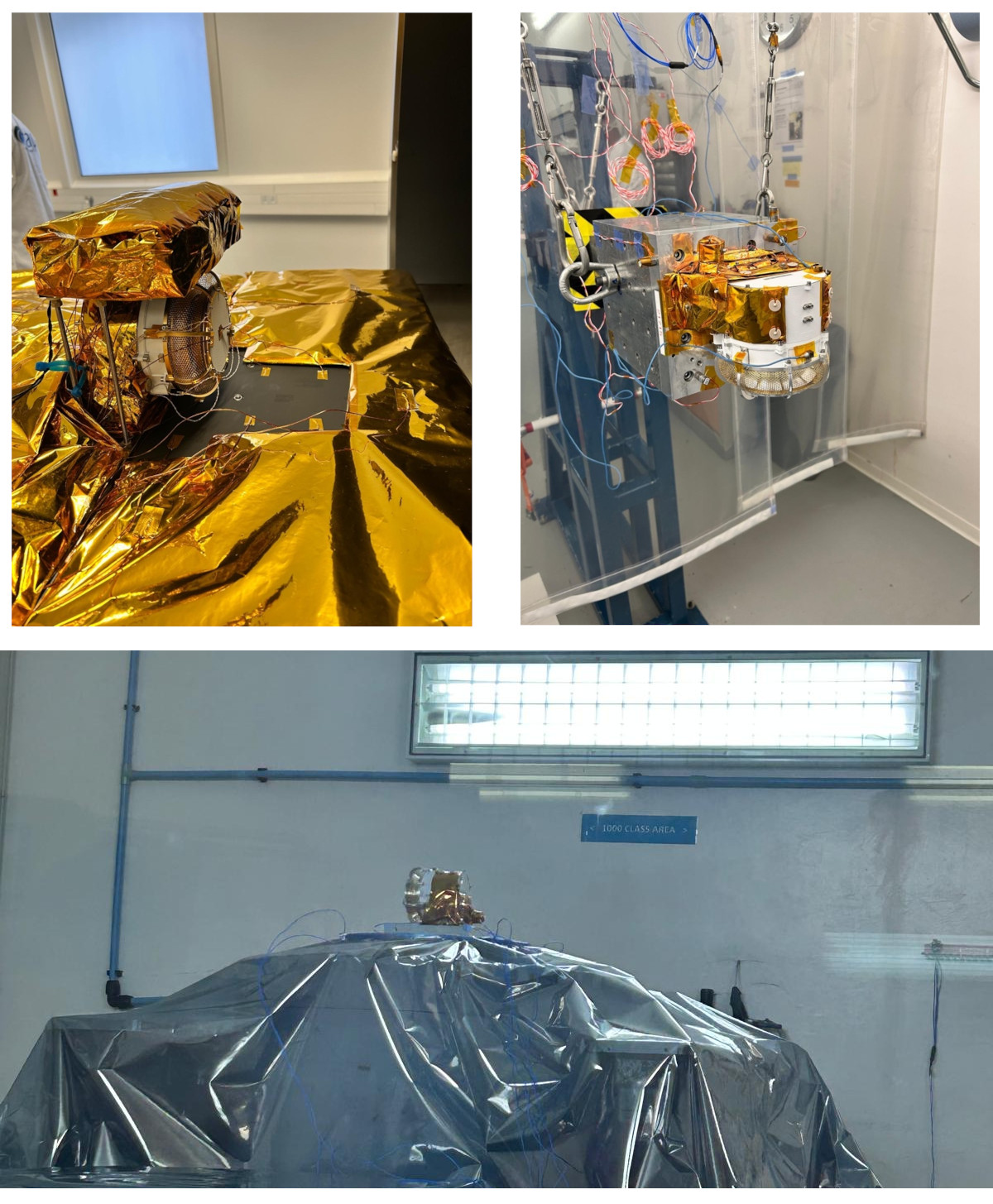
LEES is part of the Dust, Fields, and Particles (DFP) instrument suite dedicated to multi-point measurements of a comet’s ionized and dusty environment. DFP will specifically measure magnetic and electric fields, plasma parameters (density, temperature, velocity), electron and ion distribution functions, Neutral Energy Atoms, the satellite potential, and the impacts of cometary dust in the solar wind and the cometary environment.
LEES is a low-energy electron spectrometer (1 eV-1 keV) designed and built by IRAP with technical contributions from Charles University in the Czech Republic and the Laboratoire d’Astrophysique de Bordeaux.
IRAP Contacts
- Carine Amoros, LEES mechanical engineer carine.amoros@irap.omp.eu
- Christophe Verdeil, LEES technical project manager christophe.verdeil@irap.omp.eu
- Nicolas ANDRE (IRAP and ISAE-SUPAERO), LEES Principal Investigator, nicolas.andre@irap.omp.eu et nicolas.andre@isae-supaero.fr